


Partnered Twitch Account for Sale: Why Buying a Twitch Affiliate, Partner or Aged Account Is a Trap, and the Legitimate Way to Reach Affiliate and Partner Status
Search for “partnered twitch account for sale” and you will find marketplaces, social posts and private sellers promising a ready-made channel with followers, an Affiliate badge or even Partner status. The pitch is simple: skip the slow early months and start streaming to an audience with the monetisation tools already switched on. The reality is very different. Twitch prohibits selling, buying, renting and transferring accounts, the ownership of a purchased channel is rarely secure, and the audience attached to it is usually fake or uninterested in you. This article explains why the idea fails, how the common scams work, what Affiliate and Partner status actually require and how to build a channel that is yours. Requirements and revenue splits change, so always confirm the current rules on Twitch’s official help pages.
What sellers are really offering
Listings use phrases such as aged Twitch account, account with followers, affiliate ready, partnered channel and verified streamer. The word “aged” suggests trust, and “partnered” suggests income. Some listings show screenshots of dashboards, follower counts and sample payouts. Others offer to hand over the email, the password and the stream key in exchange for payment through a channel that offers no protection.
What you actually receive, if anything arrives, is a login to a channel that was created by someone else, with an audience that followed them for their own content. There is no reason for those viewers to stay when a stranger starts streaming under the same name. In many cases the followers were bought in bulk or generated by bots, so the channel looks big but has almost no live viewers. Platforms detect that mismatch, and it can lead to restrictions.
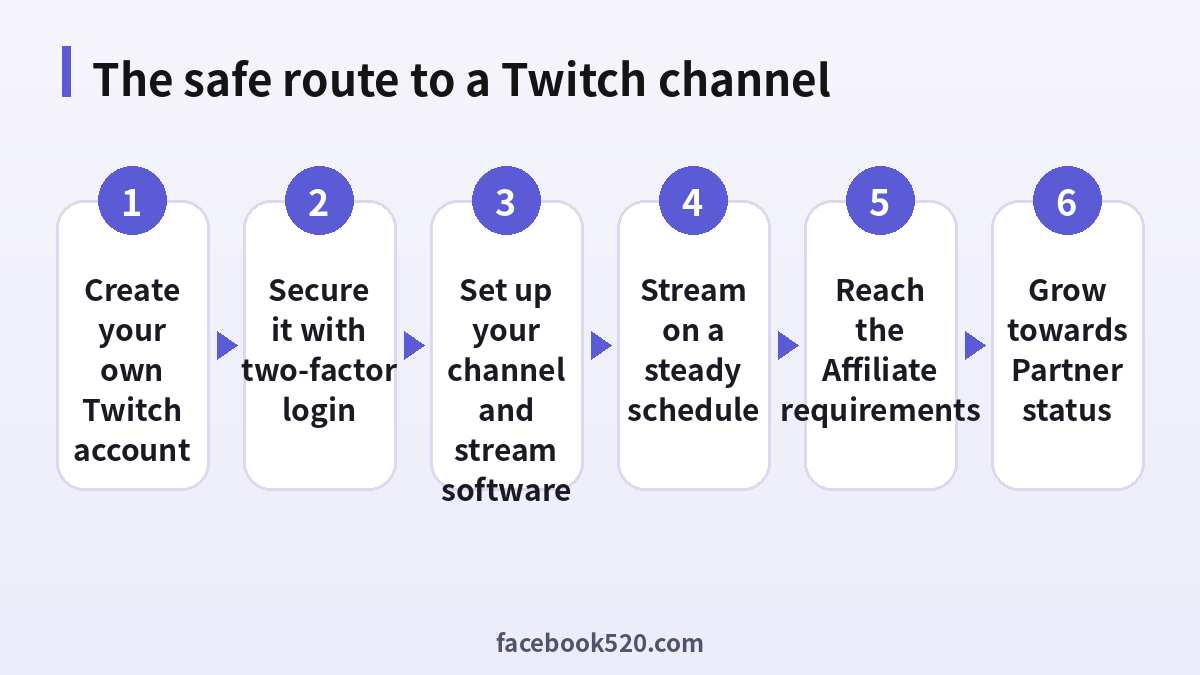
Why buying a Twitch account breaks the rules
Twitch’s terms of service do not allow users to sell, transfer or lend their accounts. The account belongs to the person who registered it, and the platform expects that person to remain responsible for what happens on it. When an account changes hands, Twitch may treat it as a violation and suspend the channel without warning. Because the buyer is not the registered owner, there is usually no practical way to appeal. The same applies to renting a channel or sharing login details with a “manager” who promises to grow it for you.
There is a second problem: payouts. Affiliate and Partner income is paid to a verified individual or company that has completed tax and payment information. If the person streaming is not the person who is registered to be paid, payouts can be blocked, delayed or sent to the seller. In the worst case, the seller still holds the recovery email and changes the password after you have paid, which means the channel returns to them and can be sold again.
| Problem | What happens | Impact on the buyer |
|---|---|---|
| Account transfer ban | Twitch can suspend the channel | Total loss of the purchase |
| Recovery email kept by seller | Seller resets the password | Channel is taken back |
| Fake followers | Few real viewers | No audience or income |
| Payout identity mismatch | Payments blocked or misdirected | No earnings |
| Prior violations | Old strikes remain on the account | Future bans are more likely |
How the scams work
Scams in this area follow a pattern. The scammer posts a convincing listing with a low price and screenshots that may not even belong to the account. They ask for a deposit, then more money for “transfer fees”, “verification” or “escrow”, and finally vanish. Another variation is the switch: the buyer pays and receives a much weaker account than the one advertised. A third variation is the boomerang, where the seller delivers a working login, waits until the buyer has invested time and money, and then recovers the account through the registered email. A fourth variation uses fake escrow websites that look official but are controlled by the seller.
Red flags include requests for payment by gift card or cryptocurrency, pressure to decide quickly, refusal to use a platform that protects buyers and listings that cannot be verified. If a deal requires you to trust a stranger with no recourse, treat it as unsafe.
What Affiliate and Partner actually require
Twitch offers two main monetisation programmes. The Affiliate programme typically requires a minimum number of followers, a minimum amount of total broadcast time, a minimum number of different days on which you streamed and a minimum average viewer count over a recent period. Once you qualify, you can apply and, if accepted, earn from subscriptions, Bits and other features. The Partner programme is for larger and more consistent channels. It asks for stronger performance and goes through a review that looks at viewership, consistency and compliance with the rules. Exact numbers change, so check the creator help pages.
The key point is that these programmes evaluate the channel’s behaviour over time and the person behind it. A purchased account may show impressive numbers, but the programme can still reject or remove it if the activity looks inconsistent or if the owner details do not match.
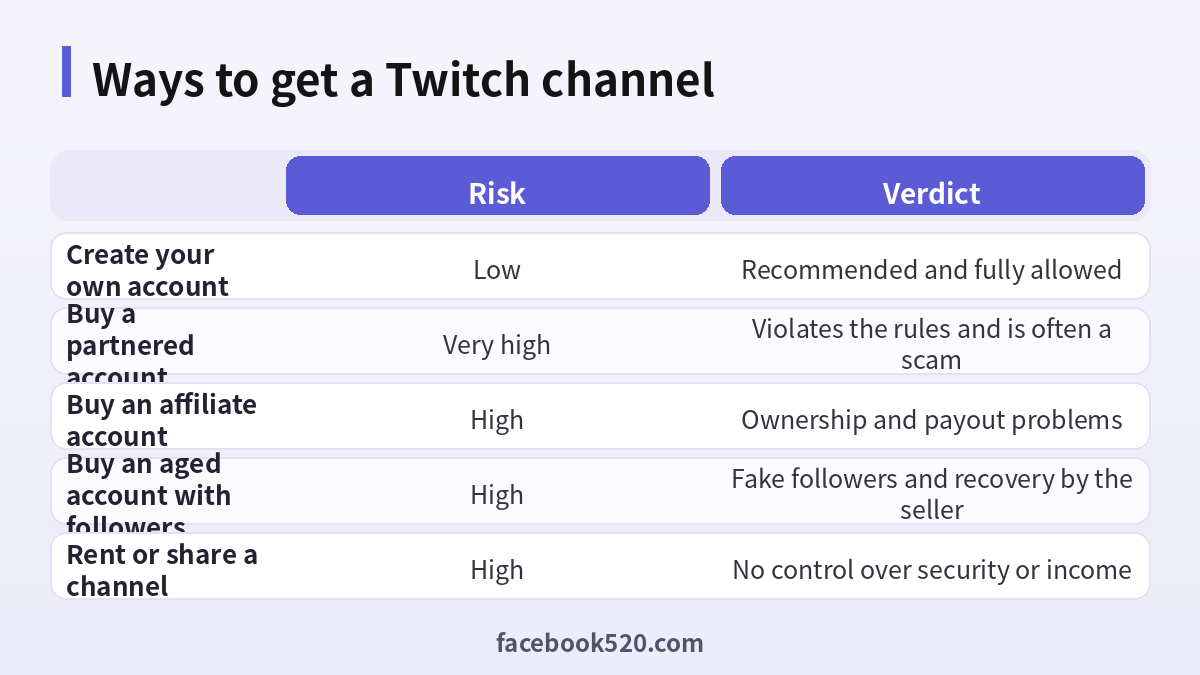
A realistic path to Affiliate
- Create your own Twitch account and verify your email.
- Turn on two-factor login in the security settings.
- Fill in your channel page with a clear description, schedule and panels.
- Choose a niche that you can enjoy for years, and a recognisable name.
- Set up broadcast software, test your audio and check your upload speed.
- Stream on a regular schedule, even if only a few people are watching.
- Engage with chat, welcome new viewers and respond to questions.
- Promote clips on short-video platforms and in communities where your audience already spends time.
- Track your progress against the Affiliate requirements in the creator dashboard.
- Apply once you meet the thresholds and follow the onboarding steps for payments and taxes.
Most channels do not reach Affiliate in a month, but a focused creator who streams consistently and builds a community can get there within a few months.
Growing a real audience
Growth on Twitch comes from three things: discoverability, retention and community. Discoverability is helped by streaming games or categories where you can stand out, using accurate titles and tags and collaborating with other creators. Retention depends on audio quality, a pleasant atmosphere and a reliable schedule. Community is built by remembering regulars, creating channel traditions and giving viewers ways to take part, such as polls, predictions and channel rewards. Short-video platforms are an excellent funnel: a funny clip posted with a link in your bio can bring new viewers who then stay for the live show.
| Growth lever | What to do | Why it works |
|---|---|---|
| Schedule | Stream on set days and times | Viewers know when to return |
| Niche | Pick a clear category or style | Easier to be found and remembered |
| Chat interaction | Reply by name | Builds loyalty |
| Clips | Post highlights on social media | Brings new viewers |
| Collaboration | Raid and co-stream with peers | Shares audiences |
| Quality | Clear audio and stable video | Keeps viewers watching |
Monetisation beyond Affiliate and Partner
Once you have a small audience, there are other ways to earn that do not depend on a badge: sponsorships, affiliate links to products that you actually use, selling merchandise, offering paid memberships on other platforms and creating content that you can reuse on other sites. These routes depend on trust, and trust comes from authenticity. A purchased audience does not buy anything, because it is not real.
Protecting your channel
Use a unique password, keep your stream key private and revoke third-party app permissions that you no longer use. Keep the recovery email under your control. Be careful with sponsorship emails that ask you to download files or sign in on strange sites, since these are a common route for account theft. If your channel is compromised, reset the password, regenerate the stream key, revoke app access and contact support.
Costs of a real channel versus a purchased one
Buyers often compare the price of an account with “free” growth and conclude that buying saves time. The comparison ignores risk. A purchased account has an expected cost that includes the chance of losing it entirely, the chance that payouts never reach you and the time you will spend trying to recover or replace it. A real channel costs time, but it also builds assets that you own: a community that knows your face and voice, a back catalogue of clips, an email list and a reputation. If you want to speed up growth legitimately, spend money on equipment, editing help, graphics and design work for overlays and emotes, and on promotion through your own content.
| Spending choice | What you get | Risk |
|---|---|---|
| Buying an account | A login that may be taken back | Very high |
| Better microphone and lighting | Higher quality streams | Low |
| Designer for emotes and overlays | Stronger brand identity | Low |
| Editor for short clips | More discovery on other platforms | Low |
| Paid followers | Empty numbers | High, can trigger penalties |
What to check if someone offers to “manage” your channel
Some services offer to run a channel for you, promising growth for a monthly fee. Ask how they plan to grow it. If the answer involves bots, follow-for-follow rings, view bots or logging into your account from many locations, decline. Legitimate help comes in the form of coaching, editing and design, and does not need your password. Keep control of the account email, the two-factor device and the payout settings. Give team members moderator roles, not account access.
Warning signs that a channel has fake followers
Even when you are only evaluating other channels, such as potential collaborators, you should know how to spot inflated numbers. Look at the ratio between followers and average concurrent viewers: a channel with tens of thousands of followers and only a handful of viewers is suspicious. Check whether the chat is active and the messages are meaningful. See whether the follower count rises in sudden jumps. Look at the channel’s clips and videos and whether they receive views that match the claimed audience. Bot-filled channels tend to have repetitive or irrelevant chat messages and no real community around them.
Setting goals that do not depend on a badge
New streamers often treat Affiliate as the finish line, but the badge is only a tool. Set goals that you control: stream a certain number of hours each week, try a new format every month, reply to every first-time chatter, publish a few clips each week and ask your regulars what they enjoy. These habits create a healthy channel whether or not you ever qualify. When you do reach the thresholds, you will already have the audience and the routine to make the most of the monetisation tools.
Taxes, payouts and legal basics for real streamers
When you earn from streaming, you become responsible for reporting that income according to local law. Set up payout details in your own name, or your company’s name, and keep records of earnings, expenses and invoices. Equipment such as microphones and cameras may be deductible in some places, but rules vary, so consult a qualified adviser. If you receive sponsorships, sign a simple written agreement that states deliverables, payment terms and disclosure requirements, and always disclose paid promotions in line with advertising rules. These steps are impossible to follow properly with an account that belongs to someone else.
Community rules and moderation
A healthy community is the reason people stay. Write clear chat rules, appoint trusted moderators and use the platform’s automatic moderation tools to filter spam and abuse. Be transparent when you remove someone, and be consistent. Protect minors and treat sensitive topics responsibly. When viewers feel safe and welcome, they come back and tell their friends, which is the most reliable form of growth.
Case study: two ways to spend the first three months
Imagine two new streamers with the same budget. The first buys a channel with twenty thousand followers. In the first week, concurrent viewers hover around two, chat stays silent and the streamer wonders what went wrong. In week three the seller resets the password, and the channel disappears together with the money. The second streamer creates a new account, spends the budget on a good microphone and an editor, streams four evenings each week and posts three clips a week. After three months the channel has a few hundred followers, an average of fifteen viewers and a regular group of chatters who greet each other by name. That channel is smaller on paper, but it is real, it is owned by its creator and it is moving towards Affiliate. The difference is the difference between a number and an audience.
Where to find legitimate help
Twitch publishes creator guides and a help centre. Many experienced streamers share advice on video platforms and in community servers, and local creator meetups can connect you with collaborators. Use these resources, and be wary of anyone who sells guaranteed growth. If you need a second opinion on a business offer, ask a trusted friend or a professional before sending money.
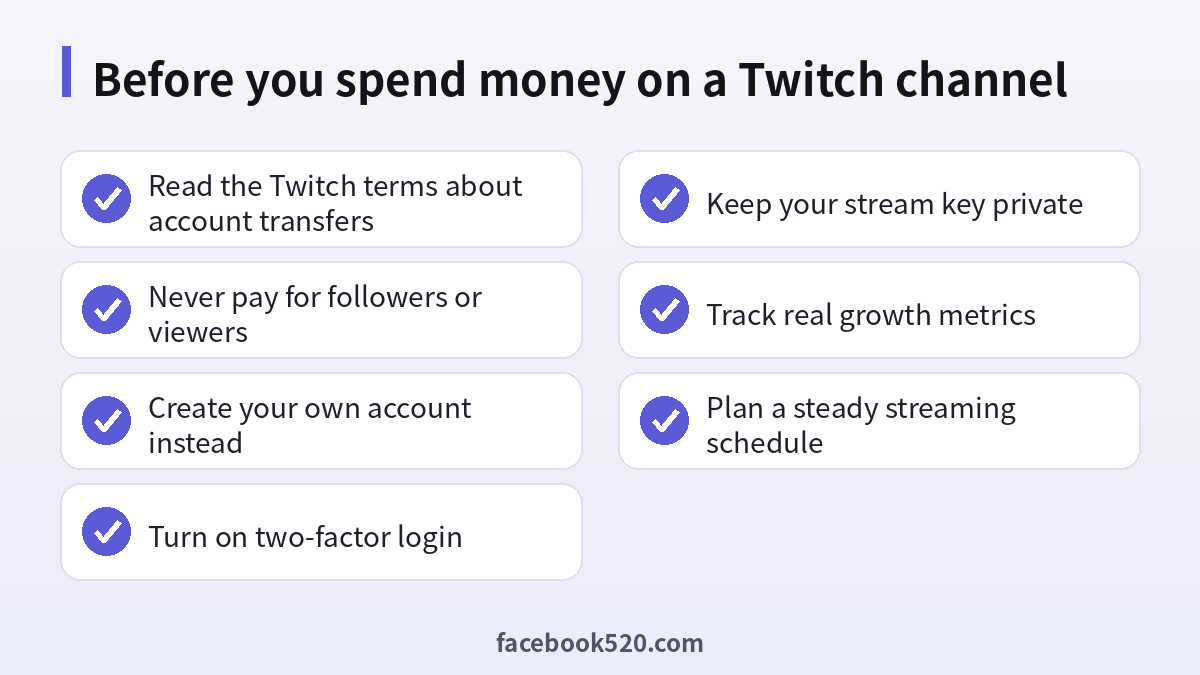
Frequently asked questions
Is it legal to buy a Twitch account?
Buying and selling accounts is not allowed under Twitch’s terms, and it can lead to bans.
Can I buy a partnered or affiliate channel?
You can find sellers, but you cannot do so safely. Payouts are tied to the verified owner, and the channel may be taken back.
Are aged accounts safer?
No. Age says nothing about trust, and old accounts may have hidden strikes.
Can I buy followers instead?
Bought followers do not watch your streams and can lead to penalties.
How long does it take to reach Affiliate?
It depends on your consistency and audience, but several months of regular streaming is common.
What if I already paid a seller?
Stop paying, secure what you can, keep evidence and ask your payment provider about disputes. Start your own channel.
Is two-factor login necessary?
It is strongly recommended, since it blocks most account takeovers.
Can I stream from someone else’s account?
Only with explicit permission from the owner and in line with the terms, and it is not a substitute for building your own channel.
How do I protect my stream key?
Keep it private, never show it on stream and reset it if exposed.
Do I need a lot of followers to be Affiliate?
The follower requirement is modest compared with the other criteria, but it must be reached in addition to them.
Can I earn without being Affiliate?
Yes, through sponsorships, merchandise and off-platform support, though these still depend on a real audience.
What should I do if my channel is hacked?
Reset the password, regenerate the stream key, revoke apps and contact Twitch support.
Conclusion
A partnered Twitch account for sale is a shortcut that leads nowhere good. The rules forbid it, the ownership is fragile, the audience is fake and the payout system is tied to the verified person. Create your own channel, stream consistently, build a real community and apply for Affiliate when you qualify. If you want another perspective on the risks of buying social accounts, our guides on buying Twitter accounts (https://www.facebook520.com/article/8265.html) and Snapchat accounts (https://www.facebook520.com/article/9526.html) explain similar problems.
