


Buy LinkedIn Accounts 2026: What Sellers Offer, Why Verified and Aged Profiles Get Restricted, and Safer Ways to Build a Credible Profile
LinkedIn is the largest professional network in the world, and for recruiters, freelancers, agencies and sales teams it is a place where a credible profile directly affects income. That is exactly why so many people search for phrases such as buy linkedin accounts, buy verified linkedin accounts or linkedin accounts for sale. They want to skip the slow part: writing a profile, collecting connections, waiting for people to trust a new name. This guide looks at what such offers really contain, why the shortcut tends to fail, what the risks are for your data and your reputation, and which legitimate routes reach the same goal faster than people expect. It does not recommend buying or selling accounts, because the network forbids it, but it does explain the market honestly so you can make an informed decision. Prices and features change often, so treat any number you see as something to confirm on the official pages.
Why people look for ready-made LinkedIn accounts
The motives are usually practical. A recruiter wants to contact candidates in a new country. A small agency wants a second profile for a new brand. A freelancer was restricted and wants to start again. A salesperson was told to reach a quota of outreach and sees a profile with five hundred connections as a head start. Others simply do not want to share a phone number or a photo. All of these are understandable needs, and each has a cleaner solution than buying somebody else’s login.
The word “verified” is the biggest attraction. On this network, verification is tied to a real person who has confirmed an identity, or confirmed a work email, and the badge appears on that person’s profile. It is not a product that can be created in bulk and handed to a customer. When a listing promises a verified profile, you should ask what is actually verified, who verified it and what will happen when the real owner notices.
What a LinkedIn account for sale really is
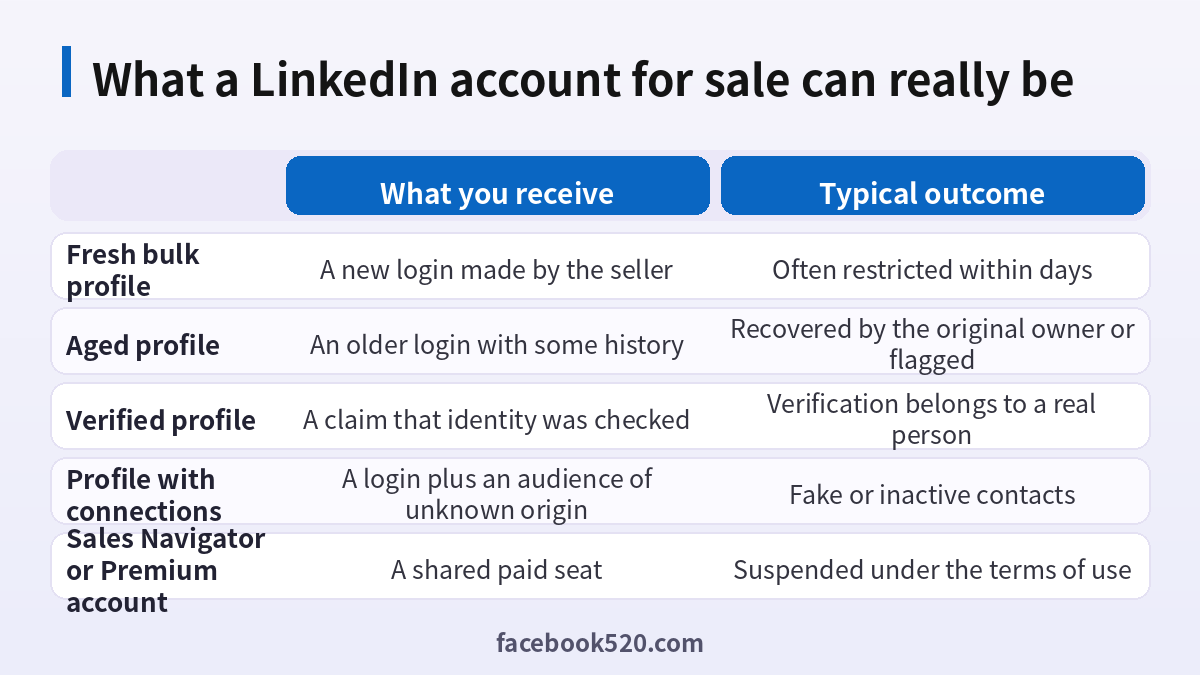
| Listing type | What you receive | Typical outcome |
|---|---|---|
| Fresh bulk profile | A new login created by the seller | Often restricted soon after first use |
| Aged profile | A login with older creation date and some activity | May be recovered by the original owner or flagged |
| Verified profile | A claim about identity or workplace checks | Verification belongs to a real person, not to the buyer |
| Profile with connections | Login plus a contact list | Contacts are often fake, inactive or unrelated |
| Premium or Sales Navigator seat | Access to a paid seat | Shared seats can be suspended under the terms |
In practice the seller keeps control of at least one thing: the recovery email, the phone number, the original device or the payment method. That is how a login can be taken back after the sale. The buyer receives a username and a password and nothing that proves ownership.
The rules you would be breaking
The user agreement of the network requires members to provide accurate information and to use their own real identity. Fake profiles, account sharing and the sale or transfer of accounts are not allowed. Automated activity that imitates a human, such as bulk connection requests or scraping, is also restricted. Enforcement is serious because the network’s value depends on trust. When an account is flagged, the typical sequence is a request to verify identity, then a temporary restriction, then permanent closure. Once an account is closed for these reasons, the person behind it may find it hard to open a new one with the same email or phone.
For a company the stakes are higher. A profile that represents your business should be connected to a real employee, and company pages should be managed by real administrators. If a purchased profile is closed, you lose the contacts, the messages and the history, and you may also have publicly connected your brand to a closed fake profile.
Risks for the buyer
- Loss of the account. The original owner or the platform can take it back at any time, and there is no recourse.
- Data exposure. Anything you type into the profile, including your real work history, connection requests and messages, sits in an account controlled by someone else.
- Credential theft. A seller who knows your payment method or email can reuse them. Some listings exist only to collect your details.
- Payment scams. Because the transaction is forbidden, there is no buyer protection. Sellers who vanish after payment are common.
- Reputation damage. Contacts see a name and photo that do not match your real identity, and people who receive messages from a mismatched profile tend to report them.
- Legal and contractual issues. Using a false identity for outreach can conflict with data protection laws and with your own employment contract.
Notice that none of these risks are theoretical. They are the reason legitimate agencies and sales teams avoid the market altogether.
Pricing: what the numbers on listings tell you
Prices for these offers vary widely, and that variation is itself a warning sign. A very cheap profile is almost always a bulk-created login that will not last. A very expensive one usually relies on the word “verified” or on a large connection count that cannot be checked. There is no official price list because nothing official is being sold. By comparison, the official paid products have published pricing: Premium plans for individuals, Sales Navigator for sales teams, Recruiter for hiring and the advertising platform for campaigns. Their cost depends on country, billing period and tax, so open the pricing page for your region before you decide anything. Compare it with the real cost of the unofficial route, which includes the chance that you will have to pay twice.
If budget is the main concern, remember that a free profile with good content often outperforms a purchased one. Recruiters and prospects look at the headline, the summary, the recent posts and the mutual connections, not at the age of the account.
What buyers say goes wrong
The most common story is the same. The login works for a few days. The buyer changes the photo and name, begins to send connection requests, and receives a prompt to verify the identity with a government document or a phone number. The buyer cannot, because the profile is not theirs. The account is restricted and later closed. The seller is unreachable, or offers a replacement that follows the same path. A second story involves a recovery: the original owner sees a login from an unknown location, resets the password and the buyer is locked out.
A third pattern affects teams. Several people share a single login to hide the number of seats. The platform detects logins from different cities in short succession and locks the account until identity is confirmed. This is the risk behind shared Sales Navigator and Recruiter offers.
Step by step: build a credible profile without buying one
Creating a profile is free and takes less time than researching sellers. These steps work for individuals and for people who need a fresh start.
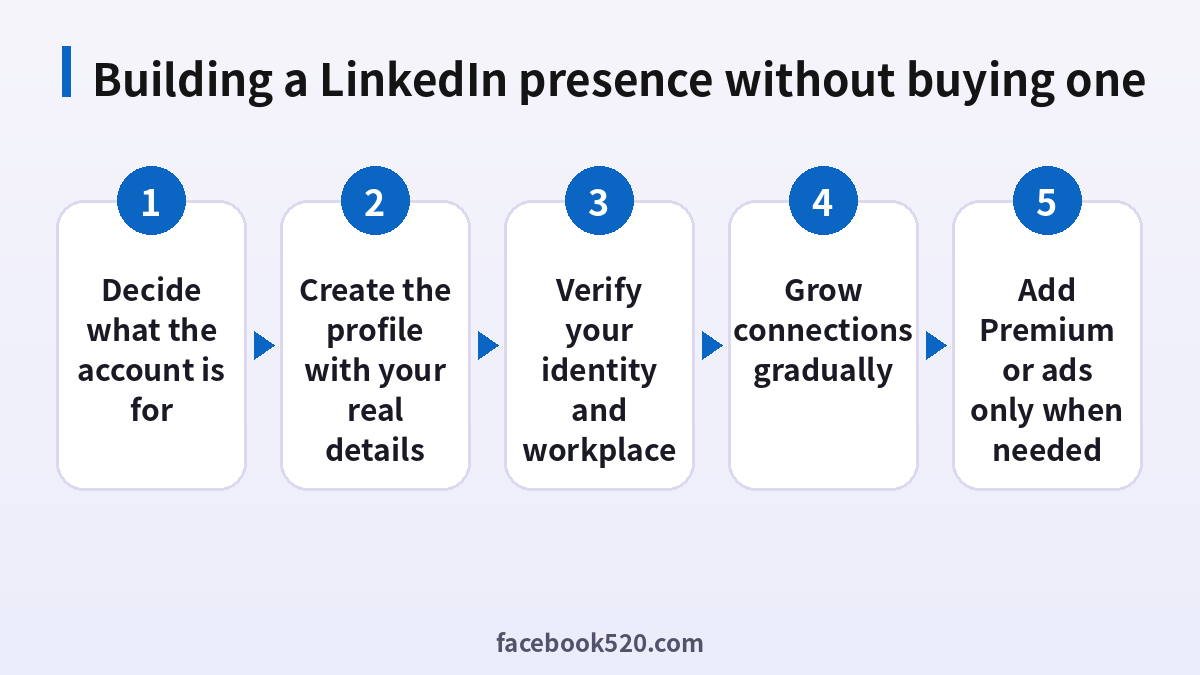
- Decide what the account is for. Job search, lead generation, hiring, personal branding and company representation need different profiles, and clarity here saves effort later.
- Create the profile with your real details. Use a professional photo, a clear headline and a summary that says who you help and how. Use an email address you control and will keep.
- Verify identity and workplace. Complete the verification options offered in your region, such as a work email or an identity check. These raise trust with recruiters and prospects more than any purchased connection count.
- Grow connections gradually. Start with colleagues, classmates and clients, then send personalised requests to people in your field. Stay within the platform’s weekly limits.
- Add Premium or advertising when it earns its place. A paid plan helps once you have a clear outreach process. Ads help once you know which audience responds.
A profile created this way is not at risk of being taken back, and it improves with every post and recommendation.
Comparing the options side by side
| Goal | Buying an account | Creating your own | Official paid tools |
|---|---|---|---|
| Speed | Fast at first | Days to weeks | Immediate after payment |
| Control | Seller may keep access | Full | Full |
| Risk of closure | High | Low | Low |
| Cost | Unclear, no refund | Free | Published, varies |
| Trust with contacts | Often damaged | Grows with time | Depends on your profile |
What if you were restricted and need a fresh start
If your own account was restricted, the first step is to follow the official appeal and verification flow, which often restores access when the cause was an automated flag. Check that the email and phone on file are current, answer the identity request carefully and wait for the review. If the account was closed for a rule violation, creating a second account to evade the closure can lead to further action, so read the notice you received and respond to it. If you changed jobs or lost access to an old email, the recovery form lets you prove ownership in other ways. Contact the support team through the help center rather than through a third party who promises to restore the profile for a fee.
Alternatives for the common needs
Outreach for a team. Give each salesperson a profile of their own, and use the official sales tools with named seats. Companies can also publish content from a company page and pay for sponsored content to reach a larger audience.
A second brand or project. Create a company page or a showcase page instead of a second personal profile. It can have its own followers and posts, and it is administered by real profiles.
Hiring in a new country. Use the Recruiter tools or job postings, which are designed for sourcing without a fake persona.
Privacy concerns. The visibility settings let you limit what appears in searches and what connections can see, and a first name with an initial for the last name is allowed in many regions. You do not need a false identity.
Fresh start after a career change. Edit the existing profile. Updating the headline, removing old roles and posting about the new direction usually works better than starting from scratch.
Pricing and payment for the official products
The legitimate paid products accept the usual cards and, in some regions, other methods such as direct debit or wallets. When you subscribe, the checkout page shows the total including local tax, the billing period and the renewal date. Save the confirmation e-mail, check which e-mail address the invoice goes to and set a reminder a few days before renewal. If you were offered a free trial, note when it ends and cancel before then if you do not want to continue. Businesses that need invoices with a tax number should enter the company details before the first payment.
How to spot a scam listing
- The seller demands payment through channels with no protection and refuses an escrow service.
- The price is far below the price of the official product.
- The listing guarantees that the profile can never be restricted.
- The seller asks for your own password, a login code or access to your inbox.
- The profile pictures and names in the screenshots look generated, and the connection counts are suspiciously round.
- The seller cannot explain how verification would transfer to you.
If you meet two or more of these signs, close the page. Do not send a deposit to test the seller. Report suspicious listings to the marketplace where you found them.
A realistic timeline for a new profile
People overestimate how long it takes to look credible. In the first week, a complete profile, a real photo and thirty to fifty first-degree connections are enough to make recruiters and clients take you seriously. In the first month, a few thoughtful posts, a handful of recommendations and active replies in your field build visibility. After three months, steady activity usually matches or exceeds the reach of a purchased profile that has a mismatched identity. No part of this requires a risky purchase.
Checklist before you decide
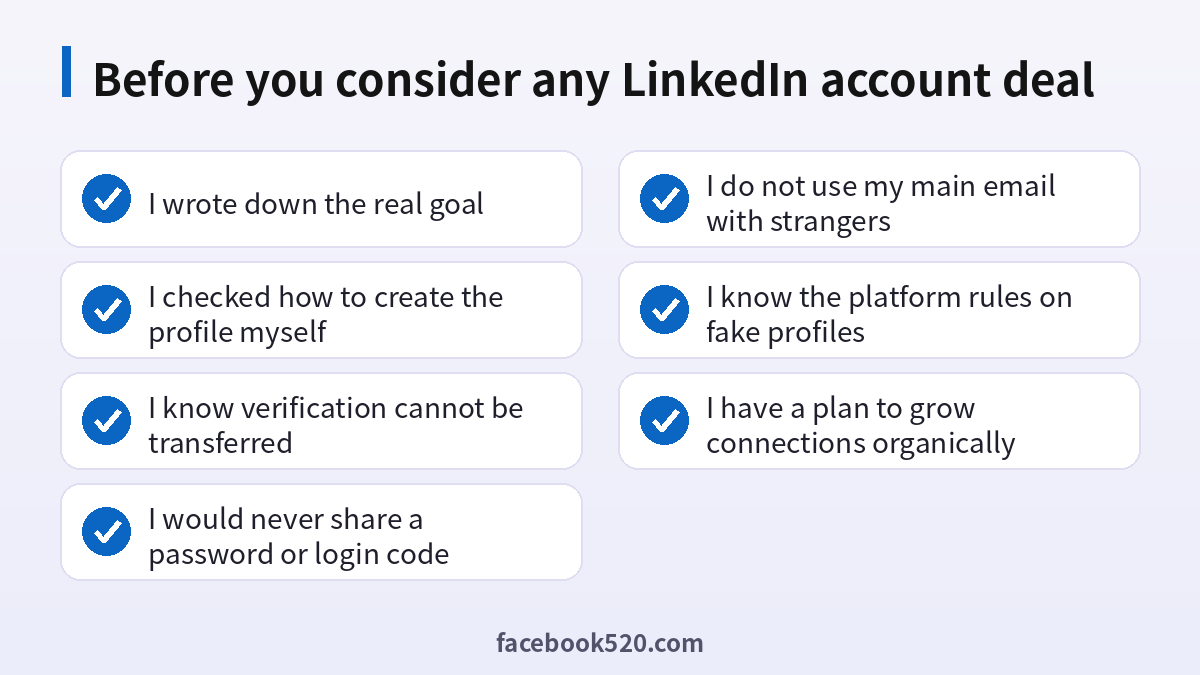
Run the checklist above before any transaction involving a professional account. If you cannot tick every item, the safer choice is to build your own profile and pay only for official tools.
Frequently asked questions
Is it legal to buy a LinkedIn account?
Buying a login is usually not a criminal matter in itself, but it violates the network’s terms, and using a false identity can create legal problems in some countries. The practical consequence is that the account can be closed without notice.
Can a verified LinkedIn profile be transferred to a buyer?
No. Verification is linked to a real person’s identity or workplace. When the profile changes hands, the verification no longer matches the user and the platform may remove it.
Why are aged accounts more expensive?
Sellers claim that older profiles are trusted more. In reality, automated systems look at behaviour, not only at the creation date, and a profile that suddenly changes owner and behaviour looks suspicious.
How can I build connections fast without risk?
Import your contacts, connect with colleagues and clients, join relevant groups and send short personalised requests. Stay within the weekly invitation limits and avoid automation tools that imitate human activity.
What is the difference between Premium and Sales Navigator?
Premium is a set of features for individuals, such as more insight into profile views and messaging credits. Sales Navigator is a separate product for lead search and tracking. Both are published on the official pricing pages.
Is it safe to share a Sales Navigator login with colleagues?
It is not recommended. Seats are meant for one person, and multiple locations on a single login can lead to a lock.
How do I recover my own old account?
Use the official recovery form, confirm the email or phone linked to the account and follow the identity steps. Avoid anyone who offers to do it for payment through private messages.
Can I run advertising without a personal profile?
Advertising needs an ad account connected to a company page and a real profile as an administrator. Payment is made in the campaign manager with a card or an invoice arrangement where available.
What should I do if I already bought an account?
Stop using it for anything that matters, do not enter personal or payment details, and do not reuse the password anywhere. Change the passwords for any services that shared a password with it, and create your own profile. Report the listing if you believe it was a scam.
Will a new profile be restricted for sending connection requests?
Sending many requests in a short time, or sending requests that are often ignored, can trigger limits. Personalise requests, keep numbers modest and engage with posts before you connect.
Do I need a company page to look professional?
A company page is useful for a business with an official brand, but it does not replace a personal profile. People connect with people, so a real founder or employee profile that links to the page is stronger.
What are the best legitimate alternatives to buying an account?
Create your own profile, verify it, use a company page for brand needs and use the official premium and advertising tools when the budget allows.
