

Sora Buy in 2026: Why You Should Not Buy Sora Codes, Credits or Accounts After the Shutdown, Plus Refund Steps, Data Export and Safer Alternatives
If you typed “sora buy” into a search engine, you probably saw ads, forum threads and social media posts offering Sora 2 codes, Sora accounts, discounted credits and “lifetime” access. Before you spend any money, read this carefully: according to OpenAI’s help centre, the Sora web and app experience was shut down on 26 April 2026, and the Sora API followed on 24 September 2026. That means there is no longer an official product to buy access to. Anything still being sold under the Sora name is either outdated, a scam or something unrelated that borrows the brand to attract clicks. This article explains what happened, how the sales pitches work, what you can still do if you were a past user, and which alternatives are worth considering. Always confirm the latest information on OpenAI’s official pages, because policies and dates can be updated.
What happened to Sora
Sora was OpenAI’s text-to-video model and creative app. When Sora 2 launched, access was limited, and invite codes became highly sought after. That scarcity created a gray market: people sold invite codes, shared logins and resold accounts. Later, OpenAI announced that it would wind down the Sora product, giving dates for the end of web and app service and for the end of the API. After those dates, you cannot sign in and generate new videos, and no purchase can restore that capability.
If you have older articles bookmarked that describe how to buy Sora credits or subscribe, treat them as historical. Pricing and plan pages that described Sora features may remain cached in search results, but they do not reflect the current situation. The safest way to confirm the status is to open the help centre article about the shutdown, rather than trusting a seller’s message.
Why sellers still advertise Sora codes and accounts
There are several reasons why offers persist after a product is gone. Search results lag behind reality, so pages written months ago still rank. Some sellers run automated listings that never get cleaned up. Others deliberately exploit the confusion: they ask for payment up front, send a fake login or a screenshot that looks convincing, and disappear. A few sell access to something else entirely, such as a different video generator labelled as Sora, or an account that can only view old content. In every case, the buyer takes the risk and the seller has no accountability.
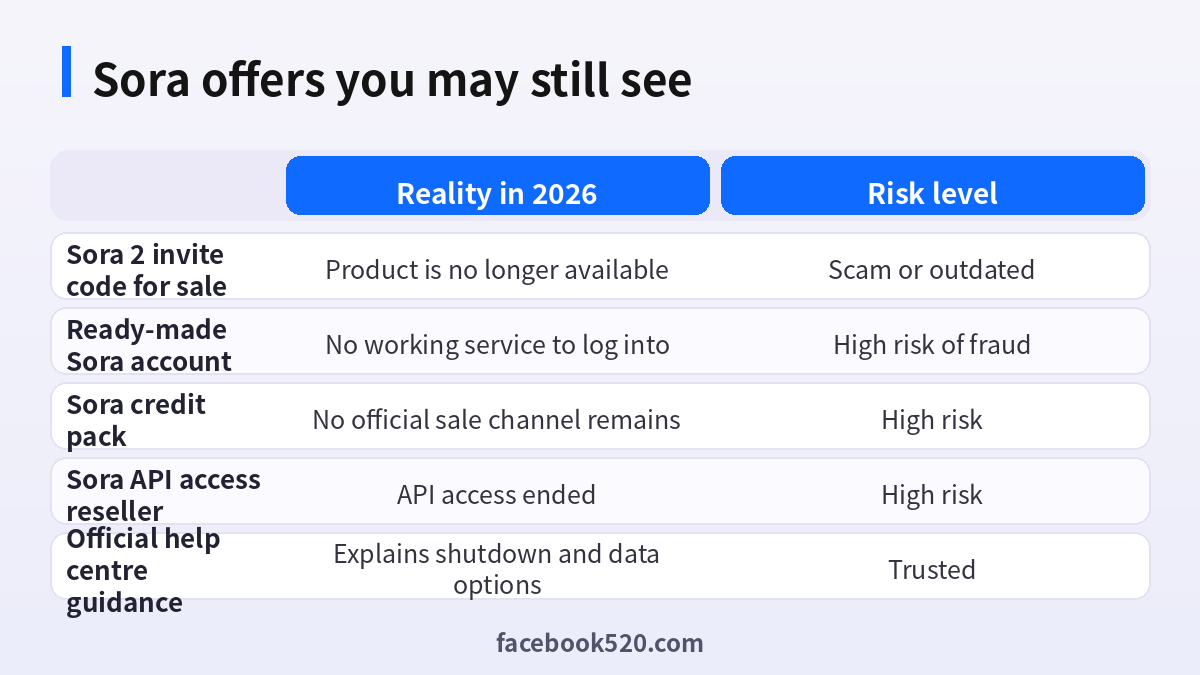
Common pitches include “Sora 2 invite code, instant delivery”, “cheap Sora account with credits”, “Sora Pro lifetime”, and “bulk Sora accounts”. Each of these has the same weakness: the product they claim to deliver is not available from the vendor, so the seller cannot legitimately provide it.
| Pitch | What it claims | Why it fails in 2026 |
|---|---|---|
| Invite code | Skip the waitlist | Invites no longer matter because service ended |
| Ready account | Instant access | No service to access |
| Credit bundle | Cheaper generations | No official channel to spend credits |
| Lifetime plan | Pay once, use forever | Product no longer exists |
| API key resale | Developer access | API ended on the announced date |
How the scams usually work
Understanding the pattern helps you recognise it in other products too. The first step is attention: an ad or video claims you can get a coveted product cheaply. The second step is urgency: limited stock, countdown timers, a discount that expires tonight. The third step is an unusual payment request, often through channels with no buyer protection, such as direct bank transfers, gift cards or cryptocurrency. The fourth step is delivery of something worthless, a screenshot, a made-up code or a login that does not work. The fifth step is silence or a request for more money to “unlock” the delivery. If a seller asks you to pay by gift card for a software product, treat it as fraud immediately.
Another risk is credential theft. Some sellers ask you to sign in on their own page to “activate” a code. That page can capture your email and password, and anyone who reuses passwords can lose other accounts too. If you already entered a password somewhere suspicious, change it on every site where you used it and enable multi-factor authentication.
If you were a Sora user: what you can still do
Past users have a few legitimate things to take care of. Keep in mind that exact steps and deadlines are controlled by OpenAI and may change, so use the official help article as your guide.
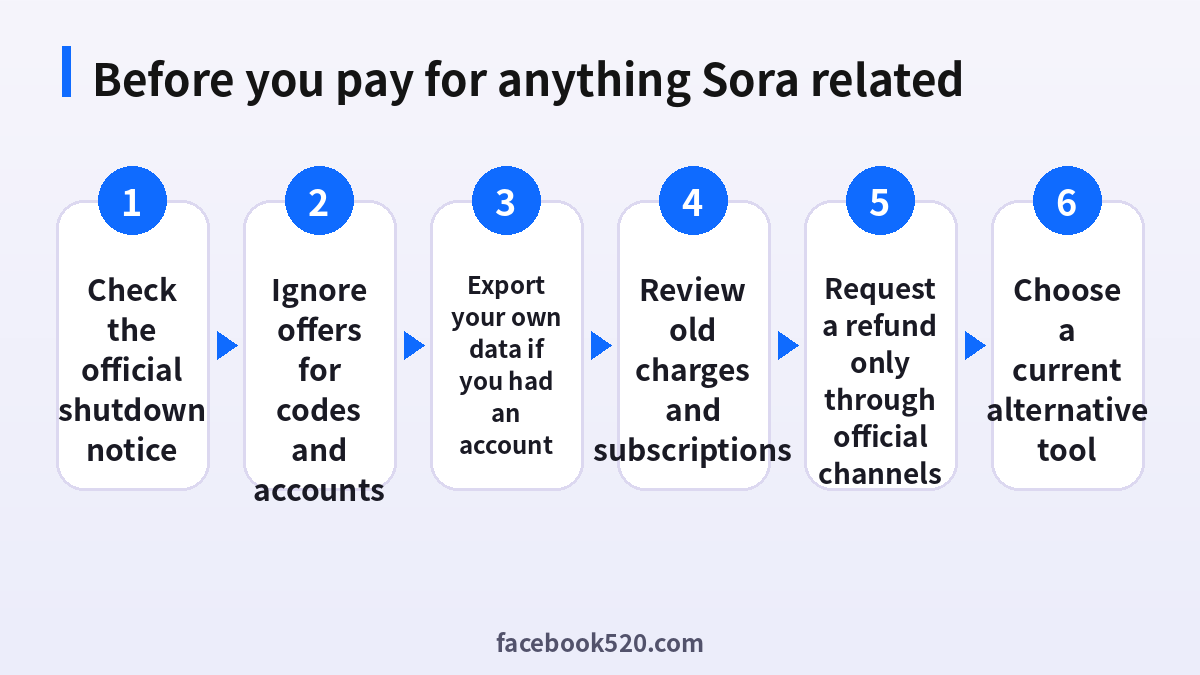
- Open the official help centre article about the Sora shutdown and read the dates and instructions.
- Sign in to your OpenAI account and look for any available option to export or download your generated content or data.
- Review your billing history to see whether you paid for a Sora specific subscription or credits.
- If you believe you are owed a refund or credit for unused paid access, follow the official process rather than contacting resellers.
- Cancel any subscription that is still active and does not provide value, so that you are not charged again.
- Save confirmation emails and screenshots in case you need to prove what you did.
Do not give your login to a third party who offers to “transfer” your remaining credits or sell your account. That violates the terms and invites account loss.
Timeline: how the Sora market formed and collapsed
The buying frenzy around Sora followed a familiar pattern. When access was limited to invited users, demand exceeded supply, and anything scarce attracts resellers. Invite codes appeared on forums and marketplaces, sometimes for a few dollars and sometimes for far more. As the app became more open, the codes lost value, but sellers pivoted to accounts with credits, to “Pro” access and to bundles. When the shutdown was announced, the legitimate reason for any of these purchases disappeared, yet the listings did not. Many were created by automated tools that copy product descriptions and keep posting regardless of whether the product still exists. Understanding this timeline helps you see why you should check the date on any article or listing: if it was written before the shutdown notice, it describes a world that no longer exists.
What “Sora” results might actually be selling
Not every result is a pure scam. Some sellers use the Sora name for other things: a bundle of stock video clips, a prompt pack, a course on AI video, or a subscription to a different generator that they rebrand. A few sell access to archived collections of videos made by others. These may be legal products, but they are not Sora, and you should compare them against what you can get directly from the official sources of the tools involved. If a listing is vague about what you receive, treat that as a warning. Ask the seller exactly what the product is, which company operates it, what the refund policy is and how you log in. Honest sellers answer clearly. Scammers dodge.
Red flags that apply to any account or code seller
A few signals appear again and again. The price is far below the official price. The seller insists on payment before showing proof. The seller refuses to use platforms that protect buyers. The listing has no history, reviews that look copied or a brand new profile. The seller asks for your password, a verification code or remote access to your device. The product description is full of promises such as “unlimited”, “lifetime” and “never expires”. The seller cannot explain how the product complies with the vendor’s terms of service. If you notice two or more of these, walk away.
Checking refunds and charges
Look at your card or bank statement for the months when you used the product. If you subscribed through the web, the charge appears under the provider’s name. If you subscribed through an app store, the bill sits with that store, and refund requests go through it. A refund is never guaranteed, and each provider has its own policy, but a clear, polite request with your order number gives the best chance. If you paid a third-party seller for a code or account that never worked, contact your bank or card issuer promptly and ask about a chargeback or a dispute. Provide screenshots of the listing, your conversation and the payment. Time limits apply, so do not wait.
| Where you paid | Where to ask | What to prepare |
|---|---|---|
| OpenAI website | Official help centre | Receipt and account email |
| Apple App Store | Apple purchase history | Order ID |
| Google Play | Google Play order history | Order number |
| Third-party seller by card | Your bank or card issuer | Screenshots and timeline |
| Gift card or crypto | Limited recourse, report to the platform | Transaction ID and chat log |
Safer alternatives for AI video in 2026
If your goal is to make AI video, you do not need Sora. Several tools offer text-to-video and image-to-video generation with their own pricing. Examples include Google’s Veo through Gemini, Runway, Kling, Luma, Pika, Hailuo and others. They differ in quality, clip length, motion control, price and commercial terms. Rather than buying a code, run a free trial or the free tier of two or three tools with the same prompt and compare the results. Check how credits work, whether unused credits expire, what the licence says about commercial use, and whether watermarks are added on free plans.
To see how credit systems and plan tiers are usually structured, our explainers on other AI subscriptions are a useful reference (https://www.facebook520.com/ai-tools-guide/ai-chat-search/8288.html) (https://www.facebook520.com/ai-tools-guide/ai-chat-search/8306.html). When you pay for any tool, do so through the official site or store and keep your receipts.
Protecting yourself after an attempted purchase
Suppose you clicked a link, entered an email or sent money. Do not panic, and act in order. First, stop all further payments, since scammers often ask for a second fee. Second, change the passwords of any account whose credentials you typed into the seller’s page, beginning with your email, because email controls resets. Third, turn on multi-factor authentication. Fourth, check your card statements and set alerts for new charges. Fifth, if you shared card details, ask your bank to replace the card. Sixth, scan your computer if you downloaded any file or extension from the seller. Seventh, report the seller and keep evidence. These steps limit the damage and strengthen your accounts against the next attempt.
Where to follow official news
For official information, use the help centre and the announcements of the vendor, not messages from sellers or reposted screenshots. Bookmark the help article about the shutdown so that you can check it when you see new offers. If you follow the AI industry, rely on the vendors’ own blogs and on established news outlets. Social media posts about “limited time” access are the least reliable of all. If a claim seems too good to be true, search for the vendor’s statement and check the date.
Budgeting for AI video without wasting money
Set a monthly budget before you start, and treat it as a ceiling. Many creators spend more than planned because credits feel abstract. Convert credits into an approximate cost per clip by dividing the plan price by the number of clips you realistically produce, including failed attempts. Use short drafts to test prompts and only render final versions at full quality. Prefer monthly billing while you are still comparing tools, and switch to annual billing only once you have used a tool consistently for several months. Cancel plans you no longer use, and record renewal dates in your calendar, so subscriptions do not quietly keep charging you.
If you publish videos commercially, read the licence terms of whichever tool you use: some restrict commercial use on free plans, some require attribution and some add visible watermarks. Keep records of the prompts and settings you used, since they are helpful if a client or platform asks about the origin of a clip.
How to teach friends and colleagues to avoid the same trap
If you work in a team, share a short rule: nobody buys software access from individuals, and all subscriptions go through company billing with a named owner. Add a step to your onboarding for new tools, which asks who the vendor is, where the terms are and how to cancel. Talk about scams openly, so that nobody feels embarrassed to report a mistake quickly. The faster a suspicious payment is reported, the more options the bank has to help.
Key takeaways before you leave this page
Remember three things. The product named in your search no longer exists, so no purchase can restore it. Past users should rely on the official help article for data, billing and refund questions. Anyone who offers you shortcuts, whether a code, an account or a bundle, is taking your money for something they cannot legitimately deliver.
How to evaluate any AI tool before paying
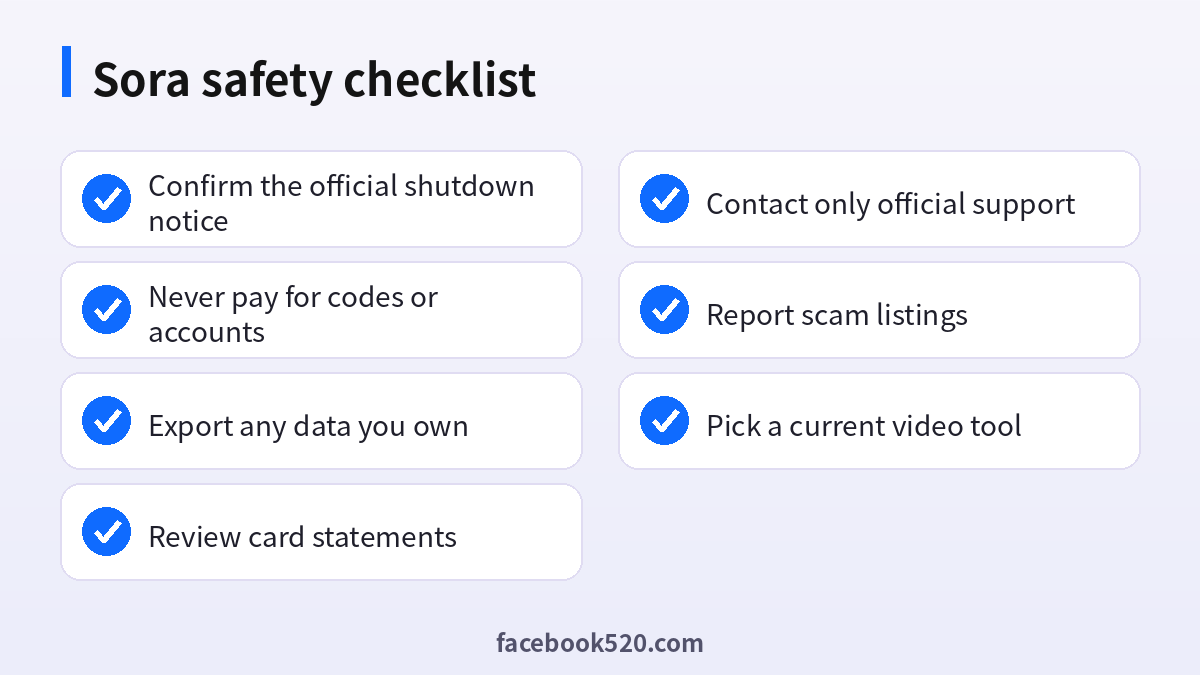
Use a simple checklist. First, verify the vendor: are you on the official domain, and does the company publish pricing and terms? Second, read the refund and cancellation policy before you pay. Third, test the free tier to see whether the output meets your needs. Fourth, check whether the product is actively maintained, with recent announcements and a status page. Fifth, avoid anything that requires you to share a password. Sixth, pay with a method that offers buyer protection. If a tool disappears, as Sora did, you want to be able to prove what you paid and when.
Frequently asked questions
Can I still buy a Sora 2 code?
No legitimate code exists to buy. Sora was shut down, so any seller offering codes is outdated or fraudulent.
Is there an official place to buy Sora credits?
No. There is no active official sales channel after the shutdown.
What if I already paid a seller?
Contact your bank or card issuer and ask about a dispute. Collect screenshots, messages and receipts.
Can I get my videos back?
Check the official help article for any export options and deadlines. Use only official channels.
Will OpenAI refund my subscription?
Policies vary. Review your billing history and follow the official process. A refund is not guaranteed.
Is the Sora API still available?
The API was scheduled to end on 24 September 2026, so it should no longer be available.
Is a cheap Sora account safe?
No. There is no service to log into, and sellers can take payment and disappear.
Why do search results still show Sora offers?
Old pages remain indexed and some sellers exploit confusion. Verify with official sources.
What should I use instead?
Compare current AI video tools using free tiers, and check pricing, licences and credit rules before paying.
Can I transfer my Sora credits to someone else?
Not through unofficial channels. Credits are tied to accounts under the provider’s terms.
How do I report a scam listing?
Report it to the platform hosting the listing, and to your national consumer protection or cybercrime body.
Should I change my password?
If you typed it on a suspicious site, yes. Change it everywhere you reused it and turn on multi-factor authentication.
Conclusion
The answer to “sora buy” in 2026 is simple: do not. The official product has ended, and the market for codes, accounts and credits is made up of outdated listings and scams. Use official guidance for refunds and data, protect your passwords, and spend your budget on a current tool that you have tested for yourself.
