

Buy Verified Nextdoor Accounts (2026): Why Address Verification Breaks Resale and What Works Instead
Search “buy verified Nextdoor accounts” and you will find marketplaces and Telegram channels promising aged, address-verified profiles in specific US cities, often bundled with “neighborhood access” for advertising. The pitch targets local service businesses, real-estate agents and marketers who want to post in neighborhoods they do not live in. This article explains why Nextdoor is one of the worst platforms to buy accounts on, what sellers are really delivering, and the free or paid official routes that reach the same neighbors without the risk.
If you are researching account purchases on other networks, our guides on buying Facebook accounts and buying old Facebook accounts cover the general scam patterns. Nextdoor has a twist that makes it even harder: everything is tied to a physical address.
How Nextdoor verification works
Nextdoor is a neighborhood network. A member account is only useful once it is attached to a verified home address, because that address decides which neighborhood feed you see and post into. Verification methods include:
- a postcard with a code mailed to the address,
- a mobile phone number whose billing address matches,
- a credit or debit card billing address,
- an invitation or vouching from verified neighbors in some areas,
- document checks in certain cases.
Nextdoor also requires real names for personal accounts. The whole trust model of the platform depends on “the person posting really lives here”. That is exactly what a purchased account breaks.
What sellers actually sell
When you buy a “verified Nextdoor account”, you typically receive one of these:
- A recycled real account. Someone’s genuine profile, sold after they moved or after the account was phished. The name and address belong to a real person who did not consent.
- A fake-address account. Verified using a vacant property, a mail drop, or a postcard intercepted at an address the seller has access to.
- An unverified shell. The seller claims verification, but the account only sees a limited preview and cannot post locally.
- Nothing. Payment collected, credentials never delivered or changed the next day.
None of these give you a lawful, stable way to speak to a neighborhood. In the first two cases you are also impersonating someone or misrepresenting where you live.
Why bought Nextdoor accounts get removed
Nextdoor’s moderation is unusually local. Neighborhood Leads and members report profiles that do not seem to belong, and the company runs automated checks on login location, device, posting patterns and address changes. Typical triggers:
- logging in from another state or country right after purchase,
- changing the email and phone immediately,
- posting promotional content in the first days,
- a name that neighbors do not recognize at that address,
- the real resident reporting the account.
Once removed, the account is gone along with any posts or recommendations. Sellers rarely replace them, and “warranty” periods are usually 24 to 72 hours.
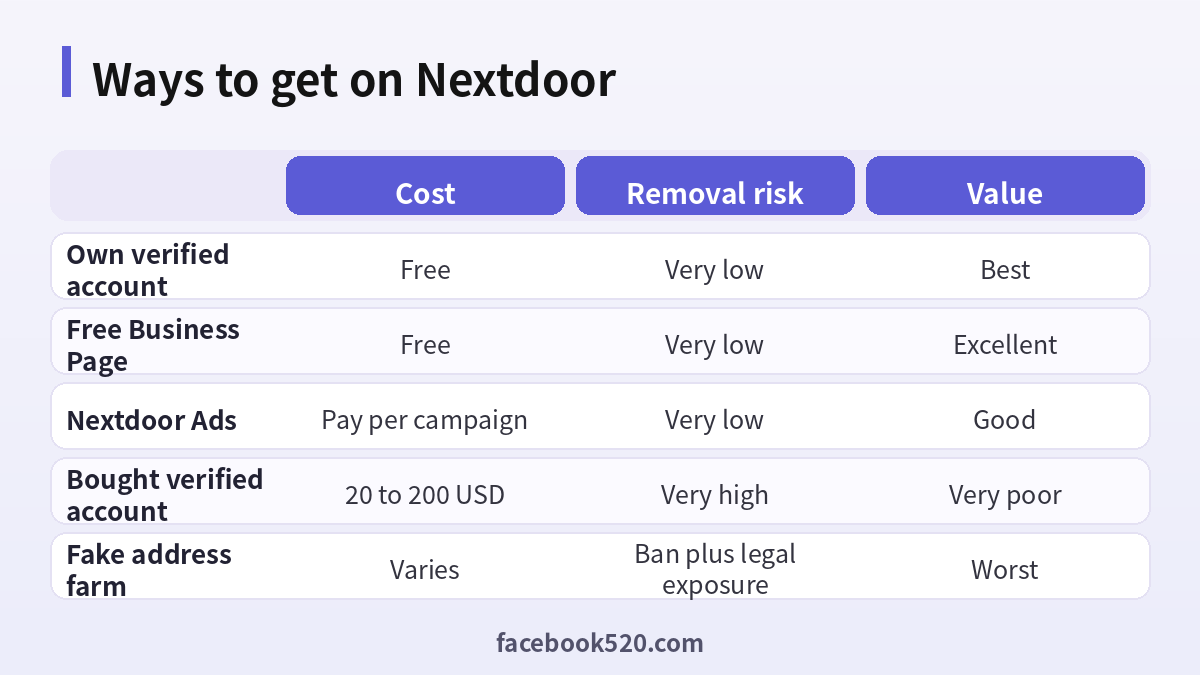
Comparison: bought account vs official options
| Option | Upfront cost | Can post in target area | Removal risk | Legal and reputation risk |
|---|---|---|---|---|
| Your own verified account | Free | Your neighborhood and nearby | Very low | None |
| Free Nextdoor Business Page | Free | Shows in nearby neighborhoods, recommendations | Very low | None |
| Nextdoor Ads (local deals, sponsored posts) | Budget you set | Chosen ZIP codes and radius | Very low | None |
| Partner with a local resident | Your time | Their neighborhood, as themselves | Low | Low if disclosed |
| Bought “verified” account | 20 to 200 USD per account | Until caught | Very high | Impersonation, ToS breach |
The free Business Page is what most buyers really need
Most people who buy Nextdoor accounts are small businesses: plumbers, cleaners, realtors, landscapers, dentists. Nextdoor gives them a free Business Page that:
- appears when neighbors search for a service,
- collects “recommendations” (Nextdoor’s version of reviews),
- can publish posts and offers to nearby neighborhoods,
- can be claimed even if you do not live in the area you serve.
Recommendations from real customers are worth far more than posts from a fake neighbor, because neighbors trust “I used them last month” much more than an anonymous ad.
Setting up a Business Page
- Sign in with your own verified personal account or create one at your real address.
- Go to the business section and choose to create or claim a page.
- Enter the business name, category, phone, website and service area.
- Verify the business (phone or other method requested).
- Ask happy customers to recommend you on Nextdoor.
- Post useful, non-spammy updates such as seasonal tips.
Nextdoor Ads for reaching other neighborhoods
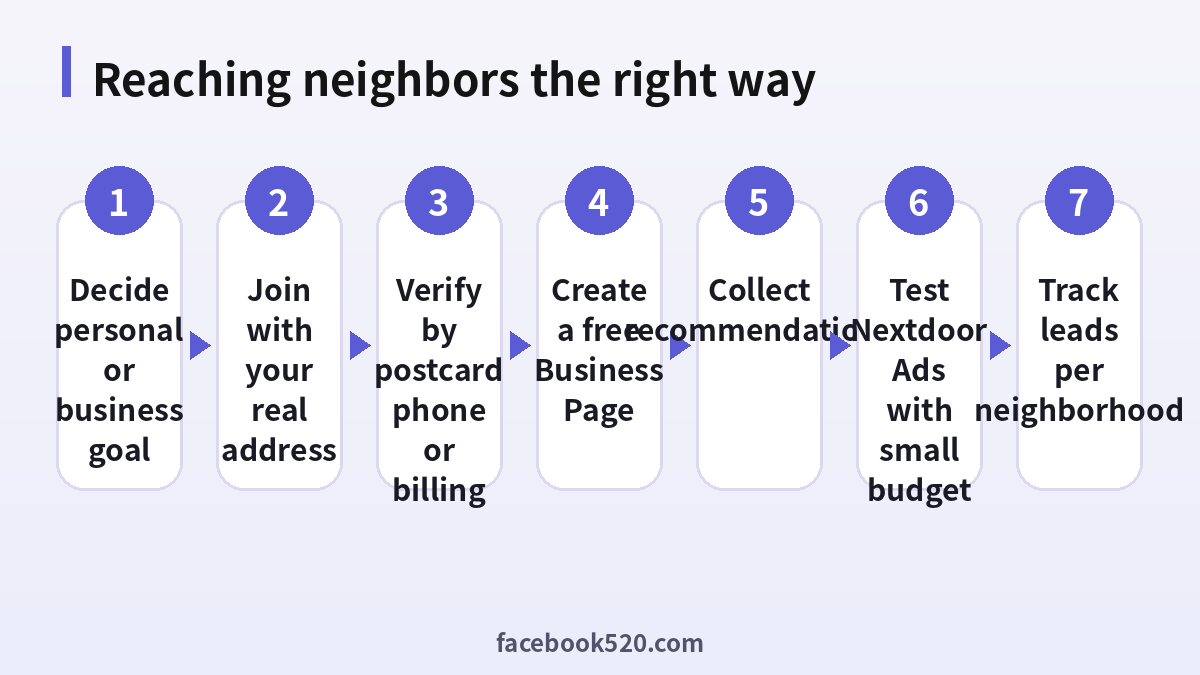
If your goal is reaching ZIP codes where you do not live, the official tool is Nextdoor Ads. You can target by location, set a daily budget, and run local deals or sponsored posts. The cost is predictable, the reach is measurable, and nothing gets deleted. Compare that with a bought account that might reach one neighborhood for a few days before removal.
A reasonable test plan:
- start with a small daily budget in three ZIP codes,
- run one offer per ZIP for two weeks,
- track calls and form leads separately per area,
- keep the ZIPs that bring customers, drop the others.
Scam signs when browsing Nextdoor sellers
| Red flag | What it usually means |
|---|---|
| Hundreds of “verified” accounts in stock | Fake addresses or hacked accounts |
| Seller asks for crypto or gift cards only | No chargeback protection for you |
| Original email cannot be changed | Seller keeps control and can reclaim |
| “Any city on request” | Address fraud |
| Very short warranty | Seller knows accounts die fast |
| Asks for your own Nextdoor login | Account theft attempt |
Legal and ethical exposure
Using another person’s identity or a false address on a platform built on real names can go beyond terms-of-service problems. Depending on your state, misrepresentation in advertising, identity misuse and consumer-protection rules may apply, particularly for regulated businesses such as real estate or healthcare. Professional licensing boards take a dim view of fake local reviews. The money saved is small compared with that exposure.
When you have moved or manage several locations
Some legitimate situations look like “I need another account”:
- You moved: update your address in settings and re-verify; your account follows you.
- You own a second home: Nextdoor has rules for secondary addresses; use the official process.
- You run several branches: create a Business Page per location or a multi-location setup.
- You are an agency: get admin access to each client’s Business Page instead of buying profiles.
For more on keeping your own accounts healthy, see our Facebook account guide and Facebook account recovery steps; the same habits (one person, one identity, secure email) apply on Nextdoor.
How to win attention on Nextdoor honestly
Neighbors respond to helpfulness. Businesses that do well usually:
- answer “who do you recommend for…” threads with a short, honest reply,
- share practical tips (winterizing pipes, storm prep, school-year schedules),
- offer neighbor-only discounts through the Business Page,
- respond politely to criticism,
- never post the same ad text in several groups.
This builds recommendations over months, and recommendations compound. A bought account cannot do any of this credibly.
A simple 30-day plan for a local service business
Instead of buying accounts, try this for one month and compare the results:
- Days 1 to 3: verify your own personal account at your real address, create the Business Page, fill in hours, service area, photos of real jobs and a clear description of what you do and do not offer.
- Days 4 to 10: message your last twenty customers and ask, politely, for a Nextdoor recommendation. Most will not reply, but five or six recommendations already change how neighbors see you.
- Days 11 to 20: post two genuinely useful updates, for example “three signs your water heater needs attention before winter”, with no hard sell. Reply to every comment.
- Days 21 to 30: run a small Nextdoor Ads test in the two ZIP codes with the most past customers, with a neighbor-only discount.
At the end, count calls and booked jobs that mention Nextdoor. That number, not “accounts owned”, is the metric that matters, and every bit of it is yours to keep.
What to do if you already bought an account
If you have already paid a seller, act quickly. Do not post business content from that account, because a removal will then be linked to your brand. Stop using it, remove any of your own payment cards or business links from it, change any passwords you may have reused, and if you paid by card, ask your bank about a dispute. Then follow the official steps above with your own identity. It is better to lose a small payment than to have your business associated with a fake neighbor.
Inside the resale market: how the numbers work
It helps to understand why sellers can offer “verified” profiles at all, because the economics reveal the risk. A legitimate Nextdoor account costs nothing to create, so anyone selling one is selling something you could not get yourself: an address. There are only a few ways to obtain addresses at scale. Sellers buy leaked credentials from data breaches and log into dormant accounts belonging to people who moved away. They rent mailboxes or use vacant rental units to receive postcards. Some recruit “account farmers” who verify at their own homes and hand over the login for a small fee, which means the account is tied to a stranger’s home, phone and card. Each of these routes leaves traces that Nextdoor’s systems and neighbors can follow back.
Prices reflect this. Unverified shells sell for a few dollars, “verified in any US city” for tens of dollars, and “aged with posting history in an affluent suburb” for much more. The premium is not for quality; it is compensation for the seller’s own risk. You inherit that risk the moment the login works.
There is also a hidden cost: time. Buyers often spend hours trying to “warm up” accounts, posting harmless content, adjusting profile pictures and avoiding detection. That same time spent collecting genuine recommendations would build an asset that cannot be removed.
What happens after removal
When Nextdoor removes an account, three things usually follow. First, any posts, comments and recommendations made from it vanish, so a campaign built on the account disappears overnight. Second, if you linked a Business Page, payment card, website or phone number, those identifiers may now be associated with a removed profile, which can make your genuine business look suspicious in future reviews. Third, neighbors who noticed the fake profile may talk about it, and on a platform where word of mouth is the product, that conversation is the opposite of marketing.
Real-estate agents should be especially careful. Local market trust is their main asset, and screenshots of a fake neighbor promoting a listing travel quickly through community groups. Brokerages and licensing bodies generally expect honest representation in all advertising, including social posts.
Questions to ask yourself before any purchase
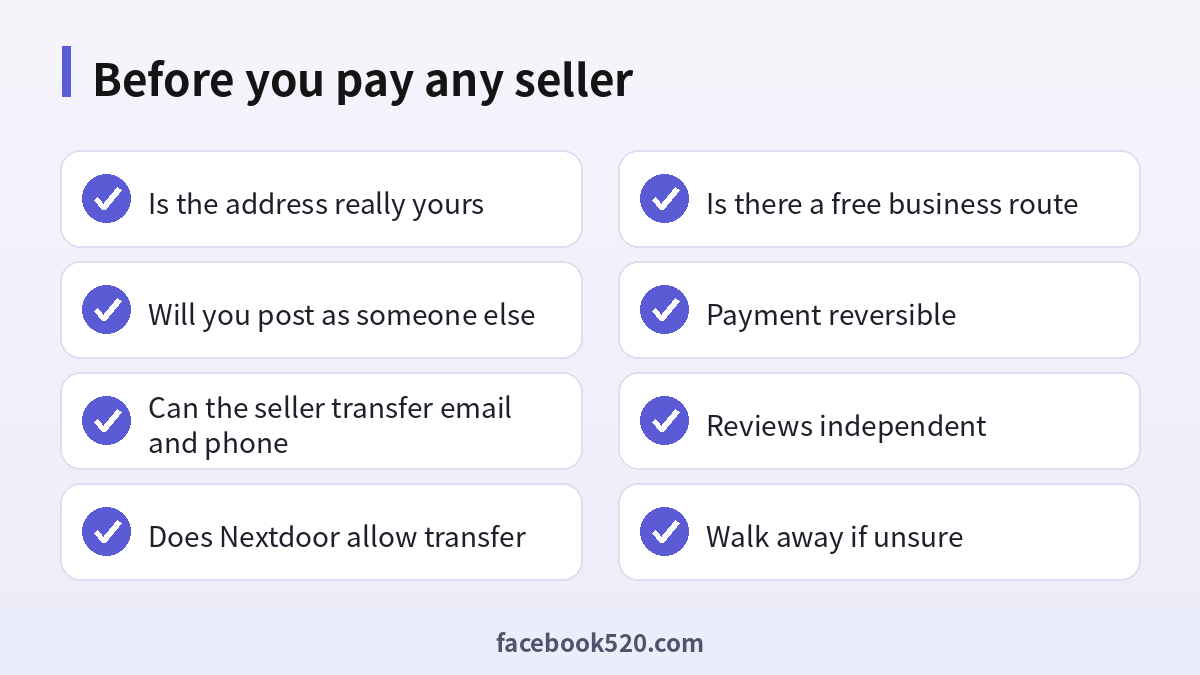
Before paying anyone, answer these honestly:
- What exactly do I want to achieve: calls, reviews, brand awareness?
- Can a free Business Page do it? In most cases, yes.
- If I need more reach, would a small ad budget cover the target ZIP codes?
- Would I be comfortable if a neighbor asked, “Do you actually live here?”
- If the account is removed next week, what have I lost?
If the answer to the fourth question is no, the purchase is a reputational risk regardless of price.
Personal account vs Business Page vs Ads: which one does what
People often blur these three, which is part of why the resale market exists. A personal account is you, as a resident, talking to neighbors. It can answer questions and recommend businesses, but Nextdoor’s guidelines discourage using it for repeated self-promotion. A Business Page is your company’s public presence; it can post updates, receive recommendations and show up in local searches across the service area you define. Ads are paid placements that appear in feeds of the neighborhoods you choose, clearly labeled as sponsored.
A bought personal account tries to make one tool do the job of the other two, and does it badly: it cannot legitimately promote, it carries no business recommendations, and it reaches only one neighborhood. Once you see the three roles separately, the official route is not only safer but simply more effective.
Measuring results without fake accounts
Track a few simple numbers each month: Business Page views, number of recommendations, messages received, calls from a dedicated tracking number, and jobs booked that mention Nextdoor. If a neighborhood produces nothing after two months of ads and posts, move the budget elsewhere. If it produces steady jobs, ask those customers for recommendations to strengthen the loop. This data-driven approach turns Nextdoor into a predictable lead source instead of a game of hide-and-seek with moderators.
FAQ
Can I legally buy a Nextdoor account?
Nextdoor’s terms tie each account to one real person and address, so buying or selling accounts breaks the rules. Using someone else’s identity can also raise legal issues.
Why are “verified” accounts so expensive?
Because verification requires a real address. Sellers either abuse real people’s addresses or use fake ones, both of which are risky for them and for you.
Will Nextdoor detect a bought account?
Often, yes. Location changes, new devices, quick edits to email and phone, and promotional posting are common triggers, and neighbors also report suspicious profiles.
How can my business reach other neighborhoods?
Use a free Business Page for recommendations and Nextdoor Ads to target specific ZIP codes.
Do I need to live in the area to have a Business Page?
No. Business Pages are based on service area, not your home address.
Can I have two personal accounts?
Normally one person has one account. Households can have separate members at the same address.
What happens to posts from a removed account?
They disappear with the account, including any recommendations it gave.
Is it okay to ask a local friend to post for me?
If they post as themselves and disclose the relationship, it is honest. Paying people to pose as neutral neighbors is not.
Are Nextdoor Ads expensive?
You set the budget. Small local tests are possible with modest daily spending.
What if a seller already has my money?
If you paid by card or a protected method, contact your bank or payment provider quickly. Do not give the seller more personal information.
How do I verify my own account if the postcard never arrives?
Try another method such as phone or card billing address, or request a new postcard from settings.
Does Facebook Marketplace work better for local reach?
They serve different purposes. Many local businesses use both; see our Facebook Business account guide.
Bottom line
Buying a verified Nextdoor account means buying someone else’s address, which is exactly what the platform is built to detect. The accounts are short-lived, the sellers are unaccountable and the reputational risk lands on your business. A free Business Page, real customer recommendations and a small Nextdoor Ads budget reach the same neighbors legitimately and keep working month after month. If you are unsure where to begin, start with the Business Page today and ask your five most recent customers for a recommendation this week.
