


Buy Facebook Accounts (2026): USA and UK Offers, Aged Profiles, Scam Signs and Safer Official Alternatives
People search for “buy Facebook accounts” when they want a login that looks established, a USA or UK profile for advertising tests, a Page with followers, or a shortcut into Ads Manager. Marketplaces and chat groups advertise aged profiles, phone-verified accounts, female or male niches, and bulk packs sorted by country. The pitch is that an older account is trusted and less likely to be restricted. This guide explains what those offers actually contain, how Meta’s systems react when ownership changes, which risks matter most, how to recognize scams, and what to do instead. We do not quote seller prices because they cannot be verified; rely on Meta’s rules and on assets you create yourself.
What people mean by aged, USA, UK and PVA Facebook accounts
Listings use a shared slang that rarely matches Meta’s own language.
- Aged accounts were created months or years ago. Sellers claim age equals trust.
- USA or UK Facebook accounts are marketed by the country of the phone number or IP used at registration. That label does not prove a real resident owns the profile.
- PVA accounts are phone verified, often with virtual numbers rather than a SIM you will keep.
- Bulk packs sell dozens of logins at once for agencies or scrapers.
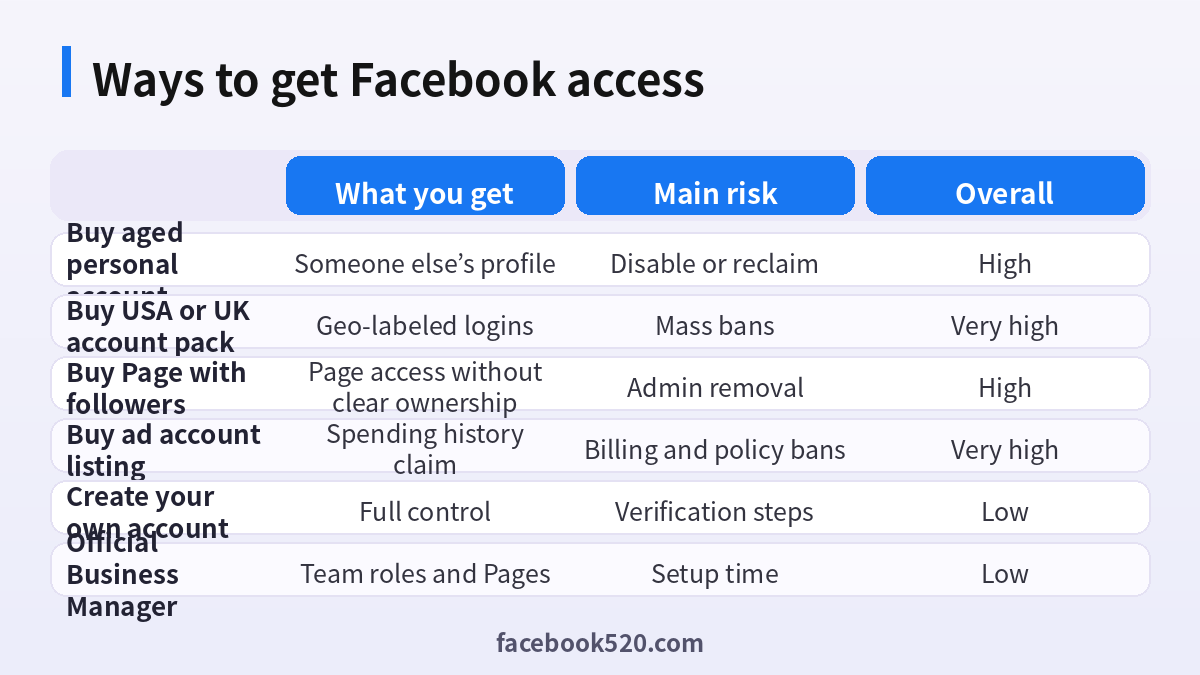
- Page accounts in casual speech sometimes mean a personal profile that admins a Page, or a Page role sold without transferring real ownership.
- Ad accounts for sale claim spending limit history or “warm” billing. Those claims are fragile and often false.
None of these terms answers the only question that matters: after payment, who can still reset the password?
Why sellers say aged Facebook accounts are better
Meta’s integrity systems look at device history, friend and interaction graphs, location consistency, payment instruments and how often an account trips checkpoints. A real person who has used one phone for years leaves a coherent pattern. An aged profile can look calmer than a brand-new one that immediately creates ad accounts and blasts messages.
Transferring the password does not transfer that pattern. When you sign in from a new country, browser or proxy, Facebook often shows a checkpoint asking for selfies, old friends, or codes sent to contacts you do not control. The older the account, the stranger a sudden ownership change looks. Our Facebook account hub explains normal sign-up, setup and payment flows when you stay on assets you own.
What you actually receive when you buy
A typical delivery is an email, a password and a short note about the phone. Reality can include any mix of the following:
- The seller keeps the original email or SIM and can reclaim the account.
- The profile was registered in a farm and shares device fingerprints with hundreds of siblings.
- The account belonged to a real person and was phished or bought through social engineering.
- Friends, Groups and Pages attached to it will report unusual behavior after you take over.
- Billing methods or Business Manager roles still point to the previous owner.
You receive a login string, not a clean legal transfer. Meta does not offer a consumer “sell my personal account” button for a reason.
Meta rules and why bought accounts get disabled
Facebook’s Terms of Service require that you provide accurate information and that you not buy, sell or transfer accounts in unauthorized ways. Fake accounts, misrepresentation and circumventing enforcement systems are prohibited. Common outcomes after a purchase:
- A checkpoint appears on the next unfamiliar sign-in.
- You cannot pass photo, video or contact verification.
- The personal profile is disabled or limited.
- Pages, ad accounts and Business Manager assets tied to that profile lose access.
- Payment methods on file can trigger billing investigations.
If the real goal is advertising, build a proper stack instead: personal profile you own, Page, Business Manager and ad account. Our guide to a Facebook business account setup covers that path. If you already lost access to a legitimate profile, use official Facebook account recovery rather than buying a replacement identity.
The risks that matter most
Loss of business assets. Pages, Groups, catalogs and pixel access hanging off a bought profile can vanish when the profile is disabled.
Ad account bans. Billing and policy history do not cleanly transfer. Spending on a bought ad account often ends in payment or policy locks that are hard to appeal.
Fraud. Sellers disappear after payment, deliver dead passwords, or reclaim the account through the original email.
Legal and compliance exposure. Using someone else’s identity for commerce, fundraising or political content can create serious problems beyond a simple ban.
Privacy. Prior owners may still read Messenger threads, see saved cards or retain admin invites you did not notice.
Brand damage. Suddenly changing the face and name on a long-lived profile looks like a hack to friends and customers.
How to recognize scam offers
Watch for these patterns:
- Extremely cheap USA or UK bulk packs sold by the dozen.
- Crypto-only payment with urgency and no written invoice.
- Refusal to explain who keeps recovery email and phone.
- Screenshots of Ads Manager that cannot be verified in a live screen share under your control.
- “Lifetime replacement warranty” with no company identity.
- Requests that you log into your own Business Manager so they can “install” an account.
- Claims that disabled accounts can be permanently restored for an extra fee.
| Warning sign | What it often means | What to do |
|---|---|---|
| Cheap geo bulk packs | Farm registrations | Do not buy |
| No recovery handoff | Seller retains control | Walk away |
| Crypto only | No chargeback | Refuse |
| Instant high spending limit | Fabricated or shared billing | High risk |
| Warranty with no identity | Empty promise | Ignore |
| Ask for your BM admin | Account takeover attempt | Stop immediately |
Safer ways to get a reliable Facebook presence
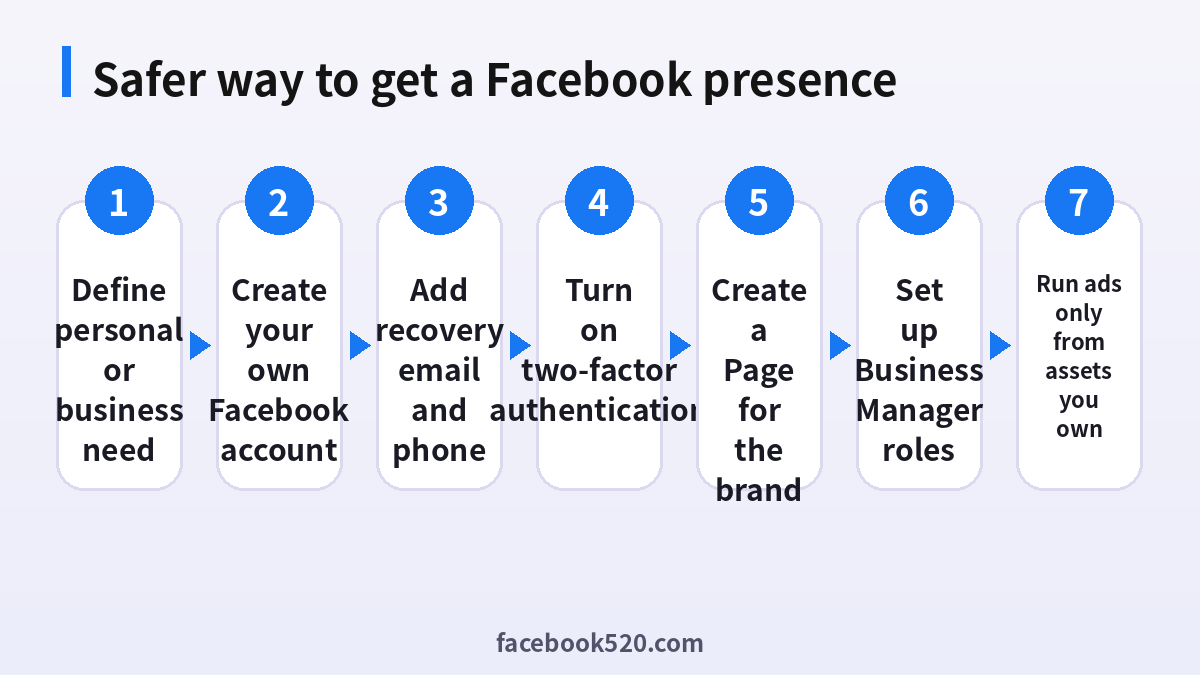
Create and secure your own account, then add business assets on top.
- Decide whether you need a personal profile, a Page, a Group, or advertising access.
- Create a personal Facebook account with your real details and a phone and email you control. Follow a clear Facebook sign up walkthrough if you are starting from zero.
- Add a recovery email and phone, then enable two-factor authentication with an authenticator app and save backup codes.
- Create a Page for the brand instead of renaming a random personal profile.
- Open Business Manager (Meta Business Suite / Business settings), claim the Page, and invite colleagues with least-privilege roles.
- Create an ad account under Business Manager with a payment method owned by the business.
- Warm personal and Page activity normally before heavy advertising. Do not blast friend requests or scraped messages.
This structure survives staff changes because roles sit in Business Manager rather than inside one fragile personal login you bought from a stranger.
USA and UK accounts: why geo labels mislead
Advertisers sometimes believe a USA Facebook account is required to run ads to the United States. In practice, targeting is set inside Ads Manager; the personal profile’s registration country is not a magic key. What matters more is a verified business presence, a valid payment method, and policy-compliant creatives. A pack of “UK accounts” registered with rented numbers usually fails checkpoints faster than a single honest account used from your real location.
If you operate across regions, document your business entity, use correct billing currencies where available, and keep personal profiles aligned with real people on your team.
Pages, followers and social proof
Some buyers do not want a personal profile at all; they want a Page with followers. Buying a Page through password sharing is unstable: previous admins can remain hidden, fan counts may be inorganic, and trademark owners can file claims. Prefer creating a Page you own, verifying the business when eligible, and growing distribution with organic posts plus official ads. Purchased likes rarely convert and can make engagement metrics look artificially weak.
Ad accounts sold in chats
Listings for Facebook ad accounts with “good limits” are among the riskiest products in this niche. Limits can be reset, payment profiles can be stolen, and policy strikes travel with the account ID. When a bought ad account fails, appeals are harder because you cannot prove legitimate business ownership. Build ad accounts inside your Business Manager and keep admin rights with people on payroll.
How to build trust the legitimate way
- Use consistent devices and networks for each real person.
- Keep names and profile photos aligned with identity checks Meta may request.
- Separate personal profiles from brand Pages.
- Review active sessions and app passwords regularly.
- Avoid browser extensions that ask for Facebook cookies or tokens.
- Document who owns each Business Manager and which payment methods fund ads.
These habits are ordinary, and that is exactly why they work.
If you already bought a Facebook account: damage control
Treat it as compromised until proven otherwise.
- Change the password. Replace email and phone if the interface allows it; if not, assume reclaim is possible.
- Enable 2FA and review logged-in devices.
- Remove unknown emails, phones and authorized apps.
- Do not attach primary payment cards or client ad budgets.
- Export any content you truly need, then move operations to assets you created.
- Save payment proof for a dispute and stop paying “unlock” fees.
Which option fits which situation
| Goal | Better path | Why |
|---|---|---|
| Personal social use | Create your own profile | Recovery stays with you |
| Brand presence | Official Page + Business Manager | Roles and continuity |
| Advertising | BM ad account you own | Billing and appeals |
| Agency clients | Partner access / clear BM roles | Audit trail |
| Testing creatives | Sandbox ad account under your BM | No seller dependency |
Business Manager versus a bought personal login
Many advertisers discover too late that Ads Manager access was hanging off a personal profile they do not truly own. Business Manager exists so that Pages, ad accounts, pixels and catalogs can outlive any single employee login. When you buy a personal Facebook account that “has an ad account,” you inherit a brittle edge case: if that personal profile fails a checkpoint, the ad account becomes unreachable even if billing still works for a day or two. Building the hierarchy correctly means every valuable asset sits in Business Manager with at least two trusted admins inside your company. That structure is also what Meta support expects to see when something goes wrong.
International teams and remote access
Remote marketers sometimes buy local-looking accounts because they work from another country. A cleaner approach is to keep real employee profiles, use strong two-factor authentication, and grant Business Manager partner access to agencies. Location changes still happen for travelers, but they happen on identities with matching documents and recovery phones. Farms that sell “local IPs included” usually rely on proxies that Meta has seen thousands of times. Those setups fail in clusters, which is the opposite of resilience.
Content authenticity and community standards
Bought profiles are frequently used to post recycled or borderline content that the original owner never would have published. Community Standards enforcement does not care that you paid a seller. Hate speech, misleading health claims, fake engagement pods and scraped reels can disable both the profile and connected Pages. If your growth plan depends on tactics that only work on disposable logins, the plan itself is the problem. Rewrite the content strategy for an account you are willing to put your company name on.
Messenger, WhatsApp and customer channels
Some buyers want a Facebook login mainly to keep Messenger threads with customers. Moving customer support onto a bought profile is especially dangerous because message history and Linked WhatsApp assets may still be visible to the previous owner. Prefer a Page inbox, official WhatsApp Business tooling tied to your business, and staff accounts that your IT team can revoke. Customer conversations are an asset; they should not sit behind a password purchased in a chat group.
Checkpoint selfies and identity loops
Bought accounts frequently enter loops that ask for video selfies or government ID that matches the original profile name. If the face and name do not match, the profile stays locked. Some sellers coach buyers to submit fake documents; that escalates from a Terms violation into more serious fraud territory. There is no ethical or practical upside. If Meta asks for identity confirmation, it should be confirmation of your own account, not a costume for someone else’s history.
Employee offboarding without bought logins
Companies that rely on a single purchased profile have no clean offboarding story when a contractor leaves. With Business Manager, you revoke a role. With a bought personal login, you argue about who knows the password. For any team larger than one person, role-based access is not optional bureaucracy; it is the only way to keep Pages and ads alive when staff change.
Frequently asked questions
Is it allowed to buy a Facebook account?
Unauthorized buying and selling of accounts violates Meta’s terms. The platform can disable the account and related assets regardless of what a seller promised.
Do USA Facebook accounts help with ads?
Not in the way sellers claim. Ad targeting and billing matter more than a marketplace geo label on a personal login.
Can I buy a Facebook Page with followers safely?
Password-based transfers are fragile. Prefer creating a Page you administer from day one and growing it with content and ads.
What is a PVA Facebook account?
Phone verified account. In bulk markets the phone is often virtual and not permanently yours.
Why do purchased accounts hit checkpoints?
Because the device, IP and behavior no longer match the history Meta stored for that profile.
What if my bought account was disabled?
You usually cannot rely on seller “warranty” fixes. For accounts you truly owned before, use official recovery flows; for bought logins, plan to replace them.
Are bulk Facebook accounts useful for agencies?
They create correlated risk. Use real employee profiles and Business Manager roles instead.
Can the seller take the account back?
Yes, if they retain email, phone or SIM access.
Should I put my credit card on a purchased profile?
No. Keep payment methods on Business Manager assets you control.
What if I already paid a scammer?
Report the seller, contact your payment provider, rotate passwords you reused, and do not send more money.
How do I start correctly for business use?
Create your own personal account, build a Page, configure Business Manager, and follow a structured business account setup.
Is account recovery the same as buying a new login?
No. Recovery restores access to an account you already owned. Buying tries to inherit someone else’s identity and usually fails under scrutiny.
Conclusion
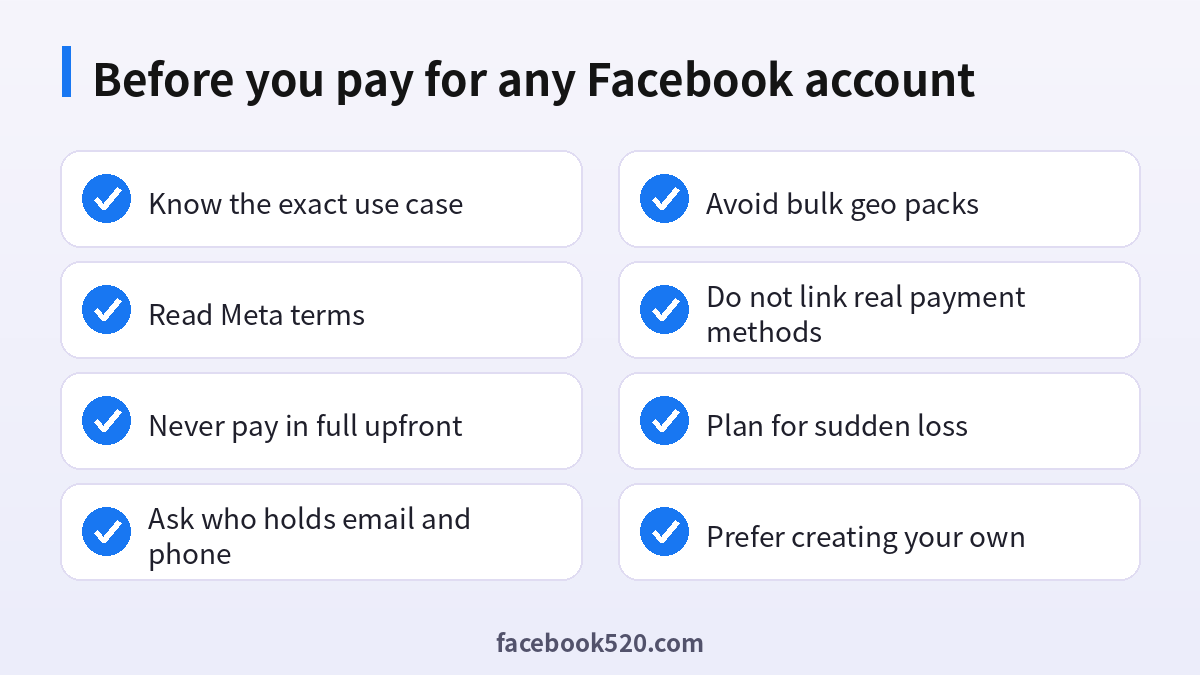
Buying Facebook accounts—whether aged, USA-labeled, UK-labeled or sold with Pages and ad limits—offers a shortcut that conflicts with Meta’s rules and collapses under checkpoints. You get a password without durable ownership, sellers can reclaim access, and business assets bolted onto that login can disappear in a single disable event. If a marketplace listing promises lifetime replacements for disabled profiles, treat that as proof the product is disposable by design. A sustainable Facebook presence is one you can still administer after the seller disappears. Create your own profile, secure recovery contacts, put brand activity on a Page inside Business Manager, and run ads from accounts your company administers. That approach is slower on day one and far more stable across the next year.
