Buy Naver Accounts in 2026: What Sellers Offer, Pricing Factors, Real Risks, a Pre-Payment Checklist and Safer Ways to Get a Naver ID
Naver is South Korea’s dominant search engine and portal. It combines search, email, blogs, cafes (community forums), maps, shopping and a payment service, and for anyone who wants to reach Korean customers it is a very important channel. That is why searches such as buy Naver accounts, buy verified Naver accounts and buy aged Naver accounts keep appearing. If you are weighing that option, this guide explains in plain English what sellers are actually offering, how prices are usually set, what the delivery process looks like, which risks are real, and what you can do instead. Platform rules, regional policies and phone verification requirements change over time, and laws on account trading vary by country, so treat this as general information and confirm current details with Naver’s own help pages.
Why people want a Naver account
The motivations are usually practical. Foreign businesses want to publish in Korean and appear in local search. Researchers want to read content that is not indexed elsewhere. Marketers want blogs and cafes, which are very influential for Korean consumers who often read reviews there before buying. Others have trouble with phone verification from abroad and wonder whether a ready-made account would be easier. These are understandable goals, but a purchased login is rarely the best route.
What “verified” and “aged” actually mean
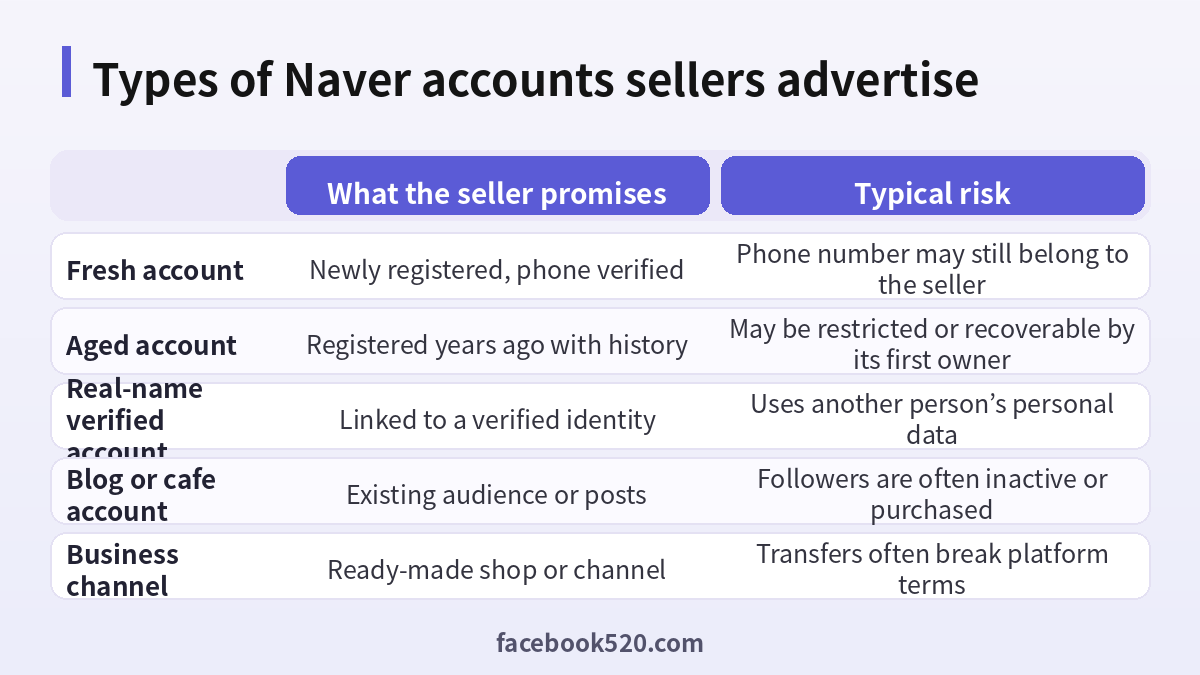
Seller listings use loose terms. The table below translates the most common ones.
| Type | What the seller promises | Typical risk |
|---|---|---|
| Fresh account | Newly registered, phone verified | The phone number may still belong to the seller |
| Aged account | Registered years ago with history | May be restricted or recoverable by its first owner |
| Real-name verified account | Linked to a verified identity | Uses another person’s personal data |
| Blog or cafe account | Existing audience or posts | Followers are often inactive or purchased |
| Business channel | Ready-made shop or channel | Transfers often break platform terms |
The word verified is the most misleading. Verification on Naver is connected to a phone number and, in some cases, to personal identity. If a seller claims the account is verified, ask whose phone number and whose identity were used. In most cases it is not yours, which means the account is not truly under your control.
How sellers set prices
Prices usually depend on a few factors: the age of the account, whether it has a verified phone number, the amount of content or followers, whether it has been used for a blog or cafe, and how quickly the buyer needs it. Bulk orders cost less per unit but are the most likely to be flagged by automated systems. Higher prices do not guarantee better quality. A pricey aged account can still be locked the day after you receive it, and a cheap fresh account can be perfectly functional until the seller takes it back. Instead of comparing prices, compare the amount of control you actually receive.
What the buying process looks like
Typically the process goes like this: you contact the seller through a messaging app, choose an account type, pay with a method that is hard to reverse, and receive a login by message or email. Sometimes the seller promises to change the recovery email after delivery. Sometimes a code arrives at the seller’s phone and you are asked to read it out. Every one of these steps is a point where you can lose money or data.
The real risks of buying
- The account is taken back. If the seller still controls the recovery phone or email, they can reset the password at any time.
- Restrictions and suspensions. Accounts registered in bulk or transferred between users can trigger automated checks and be limited.
- Identity problems. Some accounts are tied to another person’s identity. Using them can raise legal and privacy concerns for both sides.
- Data exposure. Anything you write or upload can be seen by whoever still has access.
- Payment loss. Sellers can disappear, and there is no buyer protection for a private deal.
- Rule violations. Platforms typically prohibit selling or transferring accounts, so even a working account can be removed.
Red flags in a sales conversation
Be cautious if a seller pressures you to pay immediately, refuses to describe where the account came from, asks you to send a verification code, offers a price far below the market, uses screenshots that look copied, or insists on payment methods that cannot be traced or refunded. If two or more of these appear together, stop the conversation.
Checklist if you still plan to proceed
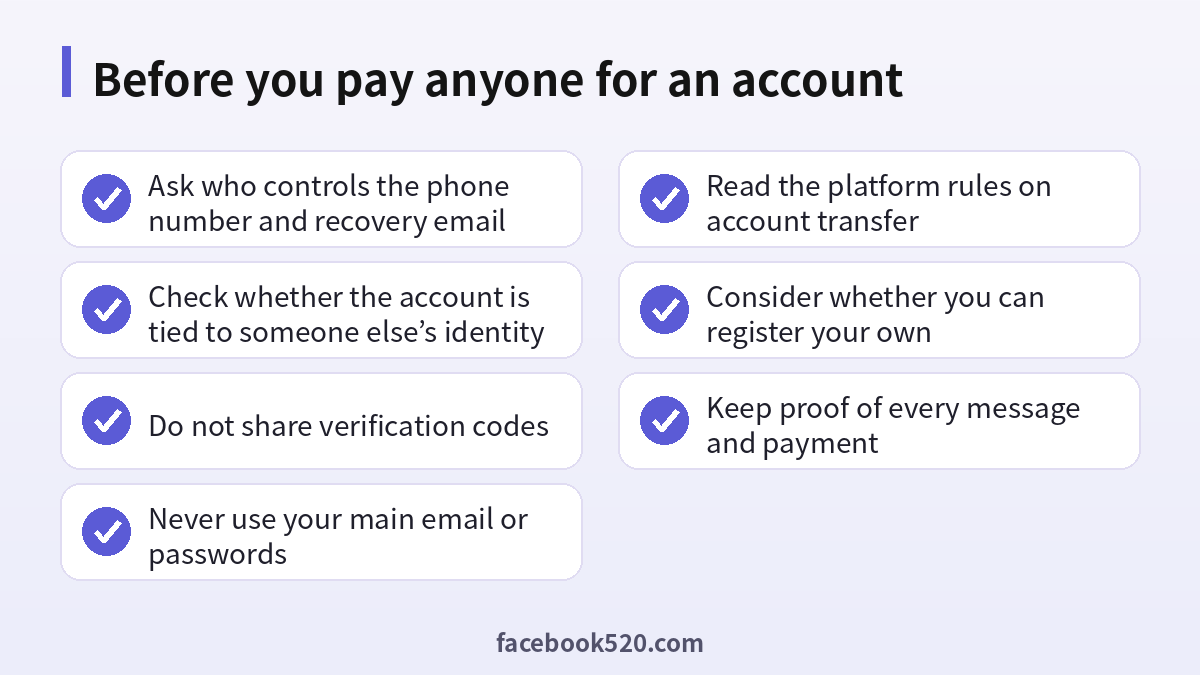
- Ask who currently controls the phone number and email attached to the account.
- Log in only on a device you trust, and change the password immediately.
- Replace the recovery email and phone number with ones you control. If this is not possible, you do not own the account.
- Check whether the account shows any warnings, restrictions or unusual activity.
- Never enter your own other accounts, banking details or passwords inside the account.
Even with all of these checks, you cannot be sure that the seller will not try to retrieve the account later. That is why creating your own account is almost always safer.
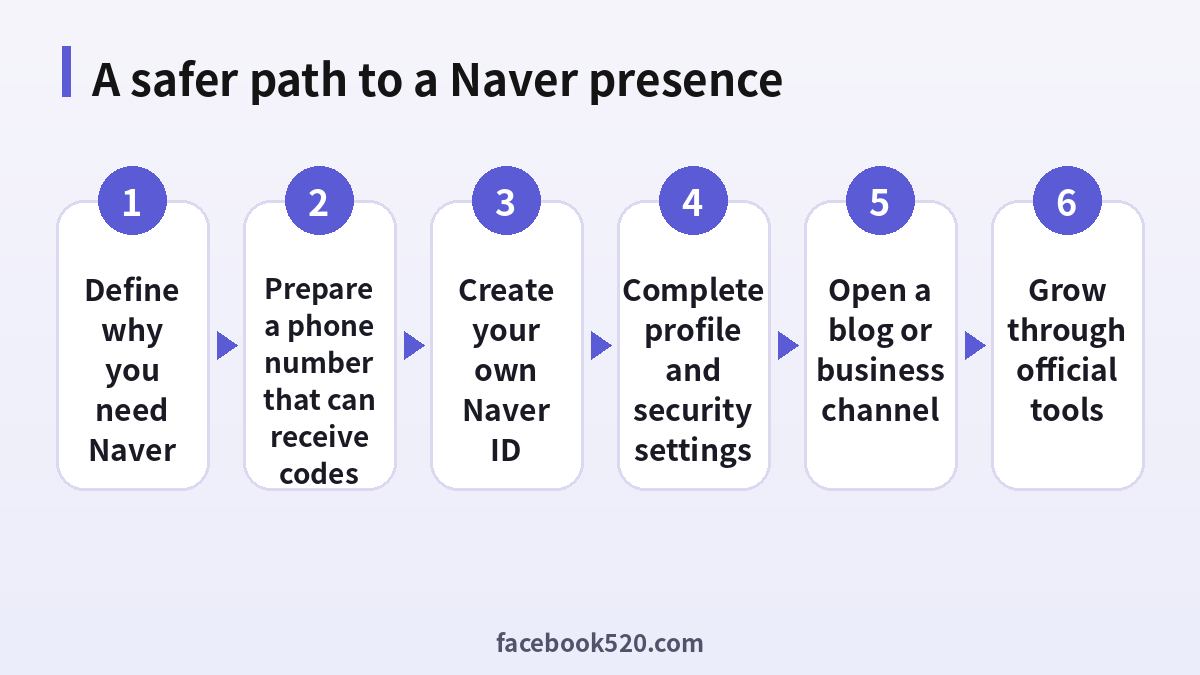
A safer approach: create your own Naver ID
| Goal | Buying an account | Registering your own | Official business tools |
|---|---|---|---|
| Control | Uncertain | Full | Full, tied to your business |
| Risk of recall | High | Low | Low |
| Cost | Unclear, no protection | Free to register | Free to open, paid promotion optional |
| Trust | Hard to build | Grows with use | Strongest for brands |
| Best for | Not recommended | Individuals and starters | Companies and long-term projects |
The sign-up process is usually straightforward. You go to the Naver sign-up page, choose a username and password, enter your name and birth date, and verify with a phone number. Depending on your country and Naver’s current rules, an overseas number may or may not be accepted, so check the options shown on the page. If you cannot receive a code, avoid unofficial verification services and consider asking a local partner or a colleague in Korea to help you set up your own account using their number under a legitimate arrangement, or use official business routes instead.
Using Naver for business in a compliant way
Many foreign companies reach Korean customers using official tools rather than personal accounts. A Naver blog lets you publish long-form content that appears in search. Cafes allow you to build a community. Naver’s business and advertising tools can help you promote a website or a shop, though some tools require Korean business registration or local payment methods. If you plan to sell in Korea, learn the requirements early, because they may affect the type of account you can open and the documents you need.
How Korean search and community behavior shapes your account strategy
Understanding how Korean users search will help you decide what kind of presence you really need. Many Korean consumers start product research on Naver instead of a global search engine, and they pay close attention to blog reviews, cafe discussions and Q&A answers. This means that a single credible blog with a consistent posting history can be more valuable than ten disposable accounts. Naver’s search results also mix several content types on one page, including blogs, cafes, shopping listings, videos and news. A brand that appears in more than one of these sections tends to look more trustworthy. Accounts that exist only to push links usually get little attention, and communities are quick to spot and report promotional posts that do not follow the rules of the board.
If you do not speak Korean, collaborate with a native speaker who understands the tone of reviews and community etiquette. Ask them to help you choose categories, write titles that match common search phrases and reply to comments. This human layer is the real asset, and no purchased login can provide it.
Timeline: what a realistic setup looks like
| Week | Task | Outcome |
|---|---|---|
| Week 1 | Register your own ID, secure it, write the profile | A clean account under your control |
| Week 2 | Open a blog or join relevant cafes as a regular member | A visible presence and early reading of the community |
| Week 3 | Publish two or three useful posts in Korean | The first indexed content |
| Week 4 | Review search keywords and reader comments | Ideas for the next month of content |
| Month 2 and beyond | Consider official business and advertising tools | Scalable, rule-compliant growth |
This timeline is slower than paying for a ready-made login, but it creates an asset that you can keep, grow and hand over to a team in a clean, documented way.
Content and language matter more than the account
An account is only the container. What drives results in Korea is high-quality Korean content, local keywords, honest reviews, fast customer service and a trustworthy brand identity. Machine translated text is easy to spot and often converts poorly. Invest in a native editor, study how local bloggers write product reviews and adapt your tone. A new but well-run account that publishes useful content consistently will outperform a purchased account filled with irrelevant history.
Security basics for any Naver account
Use a long unique password, enable two-step verification, keep your recovery information up to date and review your login history regularly. Avoid logging in on public computers, and be careful with phishing messages that imitate Naver. If an email asks you to confirm your account through a link, open the site directly instead. For team accounts, avoid sharing a single login by giving each person a separate account and managing roles in the business tools.
What to do if you already bought an account
Stop using it for anything sensitive. Try to change the password and recovery details. If you cannot, treat the account as lost. Save your chat history and proof of payment, report the seller to the payment provider if you were deceived, and change the passwords of any service where you reused the same credentials. Then follow the safer route above and build your own presence.
Cost of buying versus creating
When people compare options, they often look only at the headline price. The hidden costs of buying include time spent chatting with sellers, the chance of buying again after a recall, the loss of content you built inside an account you do not own, and the damage if sensitive data is exposed. The cost of creating your own account is a phone number and an hour of setup. Over a few months, creating your own is nearly always the cheaper and more reliable option.
Common scenarios
A foreign shop owner wanted a Naver blog quickly, bought an aged account, and lost it within a week when the seller reset the password. He later created his own blog and added a Korean-speaking freelancer to write posts.
A researcher needed to read cafe posts and found that browsing public content did not require an account at all in many cases. She registered a personal account for the rest.
An agency wanted dozens of accounts for different clients. Instead of buying them, it used official business tools and assigned roles to team members.
Pre-payment checklist
Questions to ask yourself before you spend any money
First, what is the real goal: reading content, communicating with customers, selling products or building a brand? Each goal points to a different tool, and in many cases a normal personal account is enough. Second, who will operate the account in the long run? If the answer is a team, you need clear ownership and recovery details that belong to your company, not to an unknown seller. Third, how will you handle customer data? If the account stores private messages or contact details, you must be certain nobody else can read them. Fourth, can you tolerate losing the account? If not, do not build your process on something you cannot control. Finally, is there an official route that achieves the same goal at a similar cost? There very often is.
Documentation to keep for your own records
Even when you register your own account, keep a record of the creation date, the email and phone number used for recovery, the person responsible, and the purpose of the account. Store this information in a secure password manager or an internal document with restricted access. If a staff member leaves, you can transfer responsibility without losing control. This habit also makes it much easier to prove that the account belongs to your organization if you ever need to talk to support.
A note on privacy laws and personal information
South Korea has strict rules around personal information and the use of identity data. Accounts that are verified through someone else’s identity can put that person at risk, and the buyer may also be drawn into a dispute. Even if you are outside Korea, your own country may have rules about handling other people’s personal data. This is another reason to avoid accounts whose origin you cannot explain, and to prefer accounts that are created with your own details and kept under your own control.
Frequently asked questions
Is it legal to buy a Naver account?
Laws vary by country, and Naver’s terms generally do not allow selling or transferring accounts. Accounts tied to another person’s identity can raise additional legal and privacy concerns.
What does a verified Naver account mean?
It usually means the account is linked to a verified phone number and sometimes an identity. It rarely means the account is verified in your name.
Are aged Naver accounts better?
Not necessarily. Platforms look at behavior as much as age, and a sudden change of user can look suspicious.
Can the seller take the account back?
Yes, if the seller keeps access to the recovery phone number or email.
Why can’t I receive the Naver verification code?
Reasons include an unsupported country or carrier, a mistyped number, network delays or too many attempts. Check the options on the sign-up page and wait before retrying.
Can foreigners create a Naver account?
Often yes, but requirements for phone verification can differ by country and change over time. Check the current sign-up page.
Should I give a seller the code I receive?
No. A verification code is a key to your account or to a new one. Do not share it with anyone.
How do I pay safely?
Avoid private deals. If you must pay anyone, use methods with buyer protection and keep records, though the safest choice is not to buy.
What can I use instead of a bought account?
Create your own Naver ID, open a blog or cafe, and use official business tools for promotion.
Do I need a Korean business registration?
Some Naver business tools require it, especially for selling. Review the requirements for the tool you want to use.
What if my account is restricted?
Follow the instructions on the page, complete any verification and contact support through official channels. Avoid paying third parties who promise to unlock it.
Can I run several accounts?
You can have more than one account for different purposes, but each must follow the rules, and automated mass registration is not allowed.

