


Google Ads Credit US (2026): Promo Codes, How to Add Funds, Billing Setup and Coupon Scam Warnings
US advertisers search for “Google Ads credit,” “Google Ads promo code,” and “add funds Google Ads” when they start a new account, join a partner workshop or see ads promising free click budgets. Promotional credit can reduce early testing cost, but it is not free money without rules — and a large gray market sells fake coupons, “funded accounts,” and billing shortcuts that end in suspensions. This guide explains how official US credits and billing work in 2026, how to add a payment method and apply a legitimate promo, what coupon terms usually require, and how to avoid scams. If you were tempted to buy a pre-funded login instead, read buy Google Ads accounts first. For identity foundation, use a clean Google business account setup.
What Google Ads credit means in practice
Promotional credit is a balance Google applies to eligible advertising costs after you meet stated conditions. Typical patterns include:
- A fixed USD credit for new advertisers in a country
- Partner or event coupons with unique codes
- Credits that unlock only after you spend a minimum amount with valid billing
- Expiration dates after which unused credit disappears
Credit usually does not equal unrestricted cash. Taxes, disallowed traffic, or ineligible campaign types may not consume credit the way you expect. Always read the offer text tied to your code.
Add funds and billing basics (US)
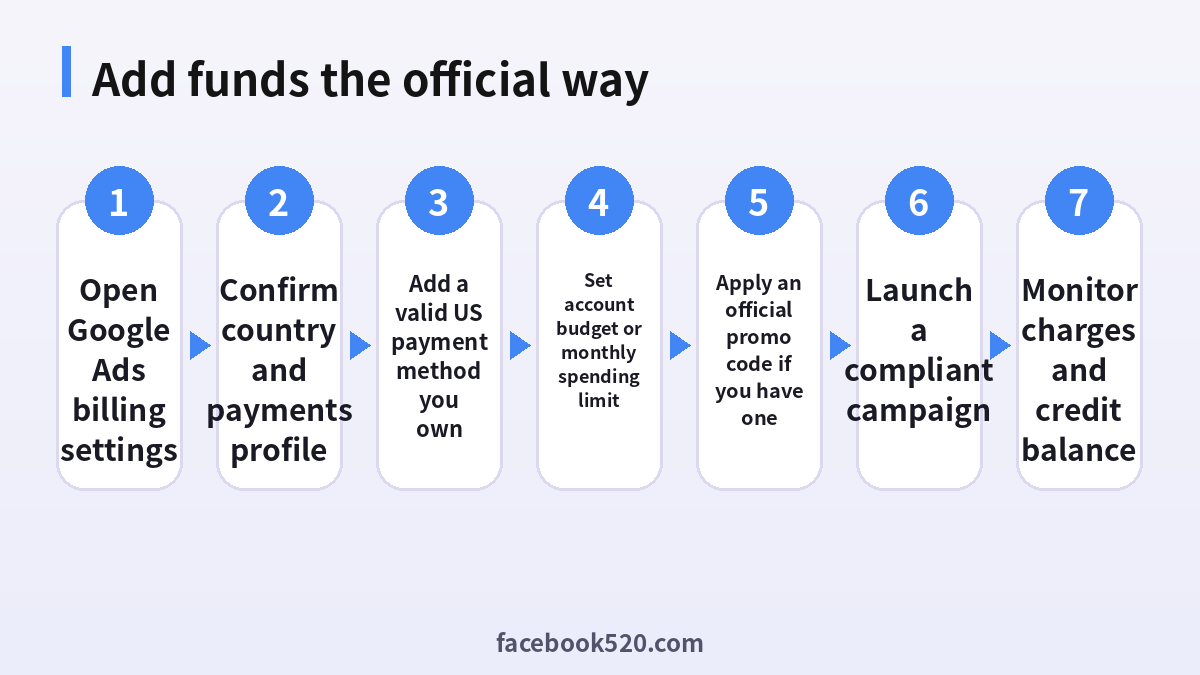
Google Ads for most US advertisers uses automatic or manual payment settings depending on eligibility and account history. Conceptually you must:
- Create or open your Google Ads account under an identity you control.
- Open Billing / payments settings and complete a payments profile with accurate legal name and address.
- Add a payment method you are authorized to use (business card, bank instruments Google supports in your profile).
- Understand whether you are on automatic payments, manual payments or threshold billing.
- Set an account budget if you need a hard ceiling for testing.
- Keep invoices and statements for finance.
- Watch email for payment failures that pause campaigns.
“Add funds” in casual language often means ensuring the account can pay invoices or, where manual payments exist, adding prepaid balance. Exact UI labels change; follow the Billing section inside your account rather than third-party screenshots.
How official promo codes usually work
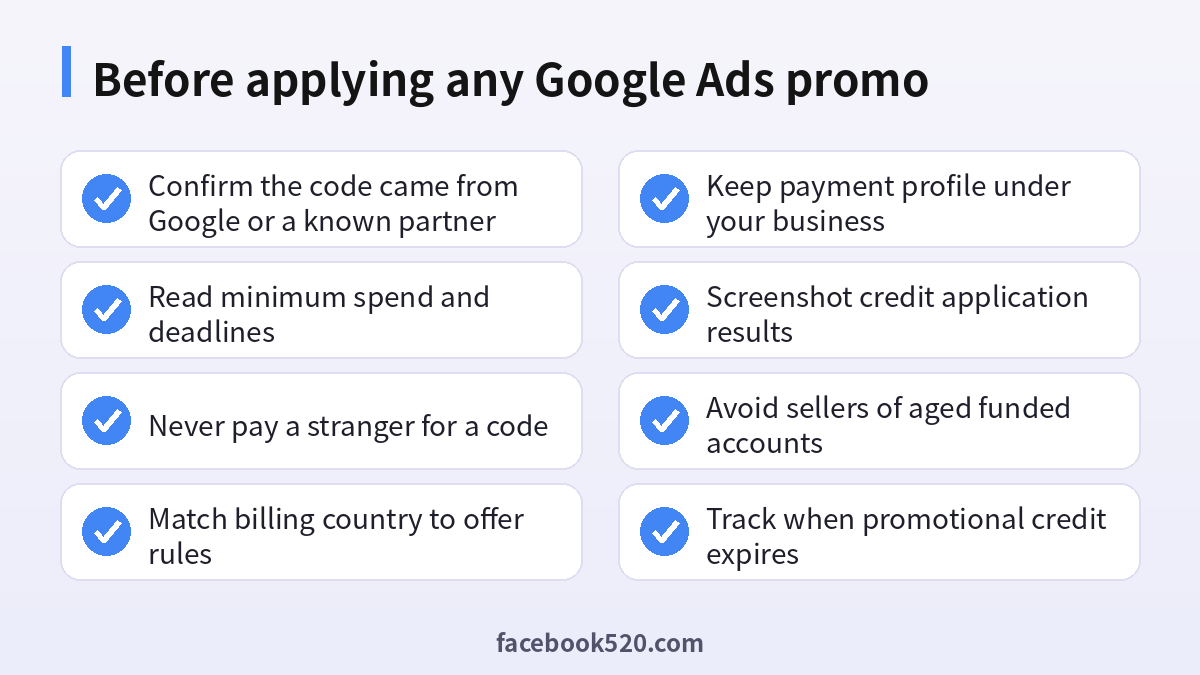
When you receive a Google Ads promo code from Google or an authorized partner:
- Sign in to the Ads account that should receive the credit — usually a new or eligible account under your payments profile.
- Find the promotions / redeem code entry in Billing or the offer redemption UI Google provides for that coupon.
- Enter the code exactly and confirm.
- Read the success message for minimum spend, eligible products and expiry.
- Run compliant campaigns that meet the spend threshold if required.
- Verify that promotional credit appears and is applied against eligible costs.
- Calendar the expiration date so you do not waste remaining credit.
If redemption fails, the cause is often country mismatch, already-redeemed codes, ineligible account age or a payments profile that does not match offer rules.
US-focused credit searches and what they imply
Queries like “Google Ads credit US” often come from:
- Startups launching domestic campaigns
- Agencies onboarding US clients who received partner coupons
- Advertisers comparing offers after seeing social posts about “$500 Google ads credit”
- People who lost access to an old account and want credit on a new one
Credit offers are frequently geo-bound. A code meant for another country may not redeem on a US payments profile, and vice versa. Do not buy “region unlock” services that ask for your login.
Promo code scam patterns to refuse
| Red flag | Likely reality | Action |
|---|---|---|
| Code sold in Telegram for crypto | Stolen, fake or phishing funnel | Do not buy |
| “Guaranteed $1000 credit today” | Misleading marketing | Verify on Google only |
| Seller needs your password to apply code | Account takeover | Stop |
| Credit tied to a bought aged account | Circumvention risk | Avoid — see suspensions guide |
| Shortened links to “redeem portals” | Credential harvest | Use Ads UI only |
| Codes that require installing remote access tools | Fraud | Refuse |
Coupons vs account budgets vs payment thresholds
These are different levers:
- Promo credit — promotional balance with terms
- Account budget — optional ceiling you set so spend cannot exceed a planned amount
- Payment threshold / automatic charges — how Google invoices your payment method as spend accrues
- Shared budgets — campaign-level budget pooling, not promotional credit
Mixing these terms in team chat causes finance errors. Write SOPs with the correct names.
Minimum spend, eligible costs and expiration
Offer terms commonly require:
- A minimum amount of actual billed spend before credit releases
- Use within a number of days after redemption
- Exclusion of certain inventory or campaign types
- One redemption per payments profile or customer
Track credit in a spreadsheet: code source, redeem date, expiry, minimum spend, remaining balance. Do not assume credit covers 100% of early invoices if terms require matching spend.
Setting up billing without drama
Practical tips for US businesses:
- Put the legal business name on the payments profile that matches contracts and tax records
- Prefer a card or instrument issued to the business when you are advertiser of record
- Avoid constantly swapping cards; it can look risky
- Keep a backup payment method on file after you stabilize
- Align time zone and currency expectations with reporting (USD for most US profiles)
- Grant Billing admin only to finance-trusted users
If Google asks for identity or business verification, complete it with real documents. Shortcuts sold as “verified funded accounts” are how people lose domains and Manager trees — details in Google Ads account suspensions wait, use B3-205.
For suspension reading after a billing or policy shock, see Google Ads account suspended.
Agency handling of client coupons
Agencies should:
- Redeem client-specific coupons only into the correct client Ads account
- Never pool unrelated client offers into one personal account
- Document who owns leftover credit if a retainer ends
- Explain to clients that unused credit can expire
- Refuse when a client forwards a “cheap credit seller” contact
Operational clarity beats surprise invoices.
When people search add funds after a payment failure
Campaigns pause when payments fail. Checklist:
- Open Billing and read the exact error
- Update expired cards
- Confirm bank fraud filters did not block Google charges
- Retry payment only from the official UI
- Check whether promotional credit is unrelated to the failure
- Resume campaigns only after balance/payment health is green
- Review missed conversions during downtime
Do not pay a freelancer who claims they can “push funds” through a hidden tool.
Credit myths that waste time
- Myth: Any Instagram code works worldwide. Reality: eligibility is strict.
- Myth: Buying an account with credit transfers safely. Reality: ownership change often kills the account.
- Myth: Credit means Google approved your niche. Reality: policy reviews still apply.
- Myth: Multiple new accounts each redeeming the same offer is smart. Reality: it can look like abuse.
- Myth: Support chat on random sites can extend expiry. Reality: only official channels matter.
Related Google spend products people confuse
Advertisers sometimes mix Google Ads promotional credit with Google Cloud credits, YouTube booster packages or Gemini plan trials. Those are different products with different consoles. If your goal is AI plan billing rather than search/display ads, see our overview of Gemini Pro plans and payment and keep Ads billing separate in finance.
Step-by-step: first compliant campaign so credit can apply
- Finish payments profile and redeem the official code.
- Install accurate conversion tracking on your site or app.
- Start with a tightly themed campaign and realistic daily budget.
- Exclude obviously irrelevant placements if using networks that need them.
- Avoid prohibited claims in copy and landing pages.
- Let the minimum spend accrue on eligible costs.
- Confirm credit application on the next statements.
Burning credit on disallowed content helps no one and can end with both credit loss and suspension.
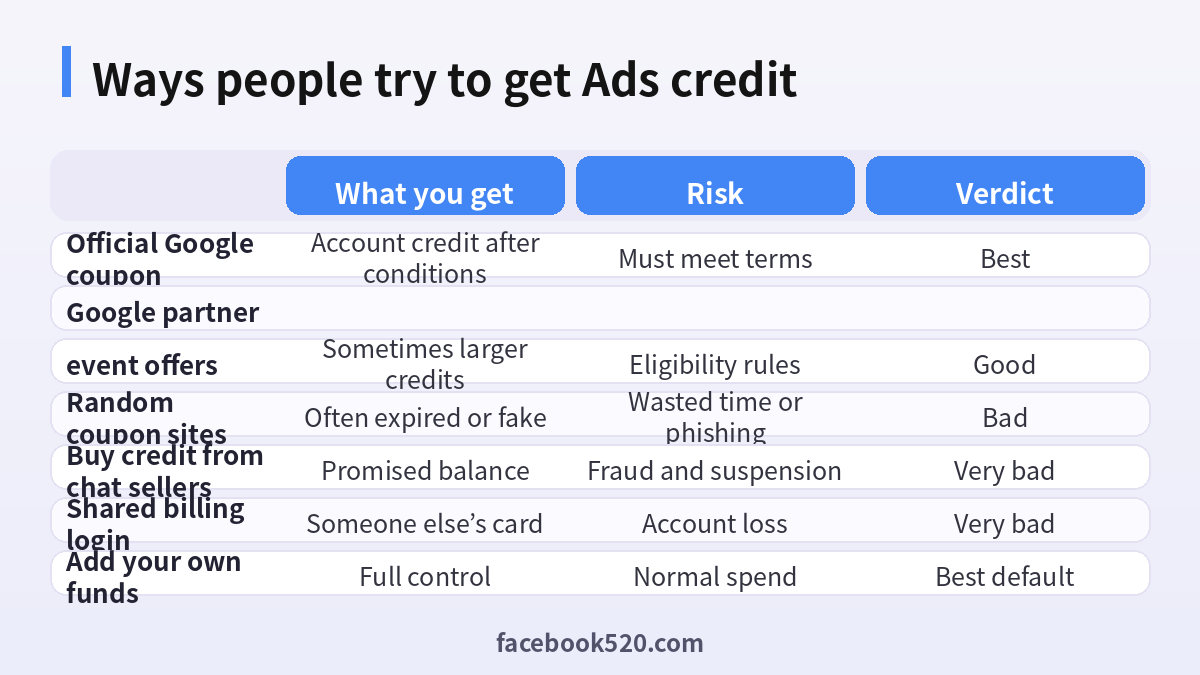
Comparison table: legitimate vs risky credit paths
| Path | Control | Compliance | Recommended |
|---|---|---|---|
| Official Google coupon | High | High | Yes |
| Authorized partner workshop code | High | High | Yes if eligible |
| Coupon aggregator site | Low | Unknown | Rarely |
| Seller of funded Ads accounts | None | Poor | No |
| Shared card belonging to stranger | None | Poor | No |
| Your own added funds | High | High | Yes |
FAQ
How do I add funds to Google Ads in the US?
Complete Billing with a valid payments profile and payment method, then follow the UI for automatic or manual payments available to your account. There is no safe unofficial top-up marketplace.
Where do I enter a Google Ads promo code?
Use the promotions or redeem area inside Google Ads Billing / offers for your account. Do not type codes into random websites.
Why did my promo code fail?
Common causes include expiry, region mismatch, prior redemption, ineligible account or payments profile rules. Read the error text and the original offer terms.
Does Google Ads credit expire?
Often yes. Expiration is written into the offer. Track dates or you will lose unused balance.
Can I buy Google Ads credit from a person online?
High risk. Many offers are phishing, stolen instruments or prepaid account flips that suspend. Use official credit only.
Will credit stop policy reviews?
No. Credit does not override Ads policies or verification requirements.
Can agencies redeem one coupon across many clients?
Usually no. Offers often limit redemption per customer or profile. Follow the written terms.
What happens if my card is declined?
Campaigns can pause. Update billing, clear the failure and restart. Check bank alerts for blocked merchant charges.
Is “Google Ads coupon 2026” from social media real?
Sometimes people reshare real partner links; often they share expired or fake codes. Verify through Google or the named partner.
Should I create multiple accounts to farm credits?
That pattern can violate rules and look like circumvention. Use one honest account structure.
Do credits appear before I spend?
Some show after redemption; many require meeting spend conditions first. Trust the offer text over forum rumors.
Can I transfer unused credit to another account?
Generally not. Assume credit stays on the redeeming account unless Google’s terms explicitly say otherwise.
Finance team checklist for promotional credit
Finance stakeholders care about recognition and audit trails more than media buyers do. Before a campaign that relies on credit goes live, align on:
- Which ledger account records promotional advertising discounts
- Whether unused expired credit needs a write-off note
- Who approves redemption of partner codes that include contractual obligations
- How agency retainers interact with client-owned credit
- Whether sales tax lines on invoices look different when credit applies
Put redemption screenshots and offer PDFs in the same folder as insertion orders. Six months later, nobody remembers which workshop produced which code.
Soft launch budgets while credit is active
Promotional credit tempts teams to spend aggressively before strategy is ready. A safer soft launch:
- Verify tracking with a tiny non-credit test charge if needed.
- Launch one campaign type you understand (for example branded search) before broad display experiments.
- Cap daily budgets so a tracking bug cannot burn the entire credit overnight.
- Review search terms and placements on day two and day five.
- Only then expand geos or creatives.
- Keep a written hypothesis for each budget increase.
- Stop spend if landing pages break — credit will not fix broken conversion paths.
Credit accelerates learning only when measurement is trustworthy.
Partner program offers versus random blogs
Authorized Google partner workshops, official startup programs and invited customer offers are the usual legitimate sources of larger coupons. Random blogs that scrape codes often publish strings that already hit redemption caps. Evaluate source quality:
- Named program with a landing page on a corporate domain
- Email from an address you can verify with the partner
- Clear terms PDF or HTML terms linked next to the code
- Support contact that is not a personal chat handle
If the only distribution channel is an anonymous screenshot, assume it is exhausted or fake.
What to do if you were phished while “redeeming”
If you typed your Google password into a fake redeem site:
- Change the Google Account password immediately from a trusted device.
- Revoke suspicious third-party app access.
- Check 2-Step Verification factors and recovery codes.
- Review Ads users and remove strangers.
- Inspect Billing for new payment methods you did not add.
- Pause campaigns if you see spend you do not recognize.
- Document the phishing URL for your security team.
Then create future redemptions only while already logged into Ads through bookmarks you control.
International teams buying US inventory
Some non-US companies still need US campaigns and ask whether they can use “US Google Ads credit.” Eligibility follows the offer and the payments profile rules, not the language of the UI. Work with legal and tax advisors when a foreign entity bills US spend. Do not buy a US person’s account merely to redeem a coupon; that combines ToS risk with tax and fraud risk.
Creative and landing page quality still matter
Credit does not improve Quality Score by itself. Before you scale:
- Align ad copy with the landing page promise
- Fix mobile page speed issues
- Remove misleading pricing callouts that trigger policy flags
- Use accurate business names in the advertiser identity fields
- Keep a change log for creatives so you can explain performance swings in QBRs
Burning promotional balance on weak creatives teaches the wrong lesson about channel ROI.
Seasonal timing for US advertisers
US retail calendars (back-to-school, holiday peak, major sports events) change CPCs. If your credit expires just before a peak, plan earlier tests so you are not forced into expensive auctions on the last redemption day. Conversely, do not sit on credit for months and then dump it in one afternoon without inventory checks.
Documentation snippet you can paste into SOPs
“We redeem Google Ads promotional codes only inside the official Google Ads interface. We never purchase codes from individuals. We store offer terms, redemption timestamps and expiry dates in the client billing folder. We do not create extra accounts for the purpose of farming coupons. Payment profiles must match the advertiser of record.”
That paragraph alone prevents most coupon-related incidents in growing teams.
When credit is the wrong tool
Skip hunting for coupons when:
- Your offer is in a restricted category that needs policy work first
- Your site cannot currently take payments or leads reliably
- You lack conversion tracking
- Leadership expects free acquisition without creative testing
- You are still deciding the brand domain that will run ads
In those cases, fix foundations, then add funds normally. A coupon on a broken funnel only buys noise.
Final recommendations
Treat Google Ads credit as a conditional discount on compliant spend, not as a product you buy from strangers. Add funds through official billing, redeem only codes you can trace to Google or a named partner, and keep payments profiles under businesses you control. That approach is slower than a Telegram “funded account,” and it is the one that still works after the coupon expires.
If your account was limited while you experimented with billing changes, prioritize reading official notices and our suspension guide before opening new accounts. Opening fresh accounts to chase another coupon often worsens enforcement. Patience with one clean payments profile beats a stack of half-redeemed experiments.
Keep Google Ads credit conversations in the same channel as budget approvals. When marketers quietly redeem codes without finance visibility, month-end reconciliations become painful and trust drops. Transparency is part of compliance culture, not bureaucracy for its own sake.
Finally, remember that “add funds” success is measured by stable delivery and readable invoices — not by the size of a one-time promotional line. Master billing health, then treat coupons as optional accelerants.

