


Tinder Accounts for Sale? Risks, Scam Signs, and Safer Alternatives (2026)
Search results for tinder accounts for sale and buy Tinder account are easy to find in 2026: marketplaces, Telegram channels, and forum threads all promise an “aged,” “verified,” or “ready to use” Tinder profile for a fee. The listings look convenient. The reality is less so. A Tinder account is tied to a phone number, a device history, and Tinder’s own safety systems. If you do not control those, you do not really control the account.
This guide explains what “Tinder accounts for sale” usually means, why those offers appear, what can go wrong (policy, scams, and recovery), how official sign-up compares with buying, and what safer alternatives exist. It is written for people who have seen the phrase in Google and want a clear answer before they pay anyone. It is not a sales page, and it does not provide a marketplace of profiles.
Important: Tinder’s terms of use are the official rulebook. Selling, buying, or transferring an account is commonly restricted, and Tinder can suspend or permanently ban profiles that violate those terms. Always read the current Terms of Use and Community Guidelines on Tinder’s official site before you act. This article is general information, not legal advice.
If you are comparing social platforms more broadly, start with our overview of Facebook, Instagram, X, Pinterest, Snapchat, LinkedIn and YouTube accounts and the longer guide to buying social media accounts worldwide. Tinder is a dating app, not an advertising platform, and the risks are different from buying a Facebook Page or a Business Manager.
What “Tinder accounts for sale” actually means
Unlike a Facebook Page or a YouTube channel, a Tinder profile is a personal dating account. It is created in the official app or website, almost always verified with a mobile phone number, and then filled with photos, a short bio, and optional add-ons such as Tinder Gold or Tinder Platinum. When a seller advertises Tinder accounts for sale, they are usually offering one of the following:
- A freshly registered profile. The seller created it with a phone number they control, sometimes in a specific country, and wants to hand over the login.
- An “aged” or “warmed up” profile. The listing claims the account has existed for weeks or months, has some activity history, and is less likely to be flagged as new.
- A “verified” profile. This may mean photo verification, phone verification, or both. Sellers often use the word loosely. Official verification is something Tinder grants to a person, not a transferable badge you can buy.
- A bundled login. Access might come as an email and password, a phone number plus SMS forwarding, or a remote-login arrangement. The last two are especially risky, because the original holder can still intercept codes.
None of these is the same as buying a business asset. You are not acquiring a brand, an ad account, or a content library. You are being offered someone else’s personal login on a dating service. That difference matters for policy, for safety, and for whether you can recover the account later.
Why do people search for “buy Tinder account”?
The search is usually practical, not mysterious. The common reasons we see in public discussions are:
- A previous account was banned or locked. The person wants a replacement without waiting or appealing.
- They cannot complete official sign-up. A phone number does not receive SMS, a number was used before, or a device is already associated with another profile.
- They want a profile in another country or age band. Some listings claim location, language, or demographic attributes as selling points. That is also where misrepresentation and policy problems start.
- They want an “aged” account to skip the new-profile period. New profiles can see tighter limits or more review. Sellers market age as a shortcut.
Those problems are real. Buying someone else’s profile is rarely a stable fix. If Tinder already restricted an account on your device, payment method, or identity signals, a purchased login can inherit the same review—or be taken back by the seller the same day.
Policy, ownership, and recovery risks
Tinder, like most consumer apps, designs accounts around one person. Phone number, email, device, payment method, and photo verification all point back to a single user. When that chain is broken, three things tend to happen.
First, the platform can close the account. If the transfer violates the current Terms of Use, Tinder does not owe the buyer a replacement. “Lifetime warranty” language from a seller has no force with Tinder itself.
Second, the original owner can often take it back. If they still have the phone number, a recovery email, or a payment method on file, they can reset access. Buyers who never received the underlying phone number are renting a login, not owning a profile.
Third, you may not be able to recover it yourself. Official support will reasonably ask you to prove that you are the person who created the account. A receipt from an unofficial marketplace is not the same as the original phone number or payment history.
There is also a safety issue that goes beyond your own login. A profile that already existed may have been used to impersonate someone, reuse other people’s photos, or message people under a false identity. Taking over that history can put you on the wrong side of Tinder’s Community Guidelines even if you did not create the content.
Scam signs in “Tinder accounts for sale” listings
A large share of these offers never deliver a usable account at all. The pattern is familiar if you have looked at other “accounts for sale” markets, but dating-app logins have a few extra tells.
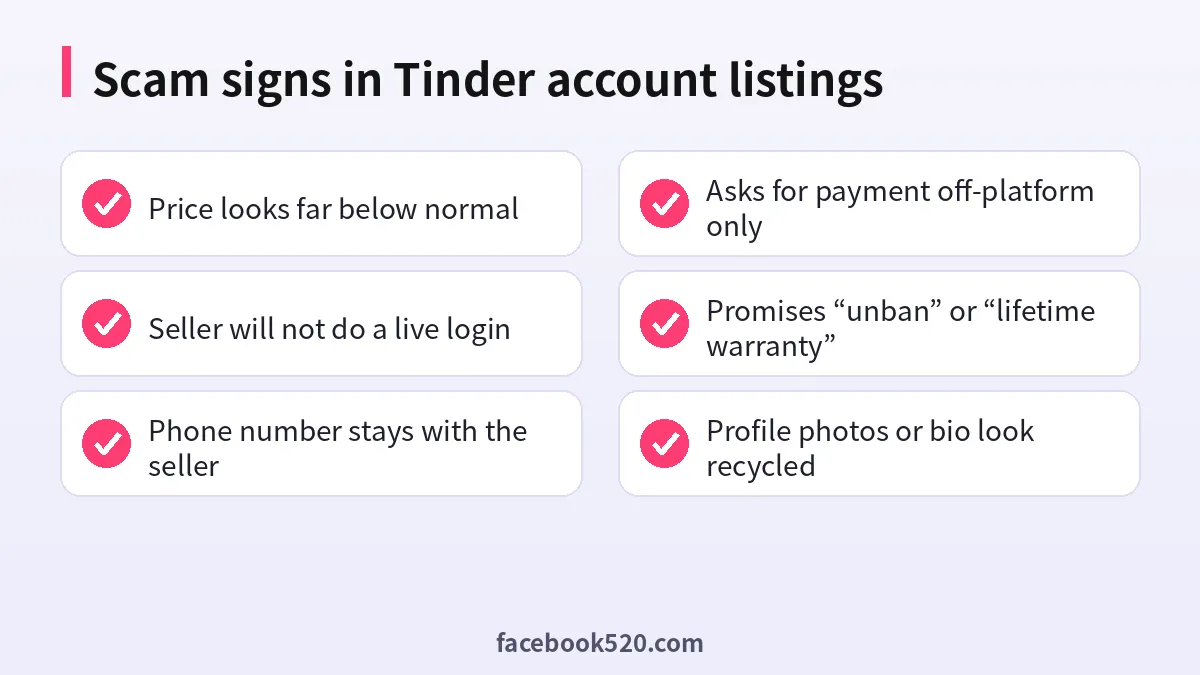
| Red flag | What it often means | What to do |
|---|---|---|
| The price is far below any typical listing you can compare | The seller may have no account to deliver, or plans to recycle one login many times | Walk away; a “bargain” is the most common hook |
| No live login, only screenshots | Screenshots are easy to fake or reuse from another profile | Do not pay for pictures of an app |
| The phone number stays with the seller, who “will forward SMS” | They keep the recovery path and can lock you out later | Treat this as a rental, not a transfer |
| Payment only through irreversible, untraceable channels | If the login fails, you have little recourse | Prefer methods you can document; better still, do not buy |
| Promises of “unban,” “anti-detect,” or “lifetime warranty” | No seller can bind Tinder’s review systems | Ignore the promise; read the actual terms |
| Stock photos, repeated bios, or profiles that appear in more than one shop | The account may be cloned, stolen, or already sold | Reverse-search images if you are even evaluating the offer |
If a listing checks two or more of those boxes, the chance that you lose the payment—or receive a login that dies within days—is high. That is the main reason a page can rank for “tinder accounts for sale,” collect impressions, and still be a bad place to click if the title does not warn you.
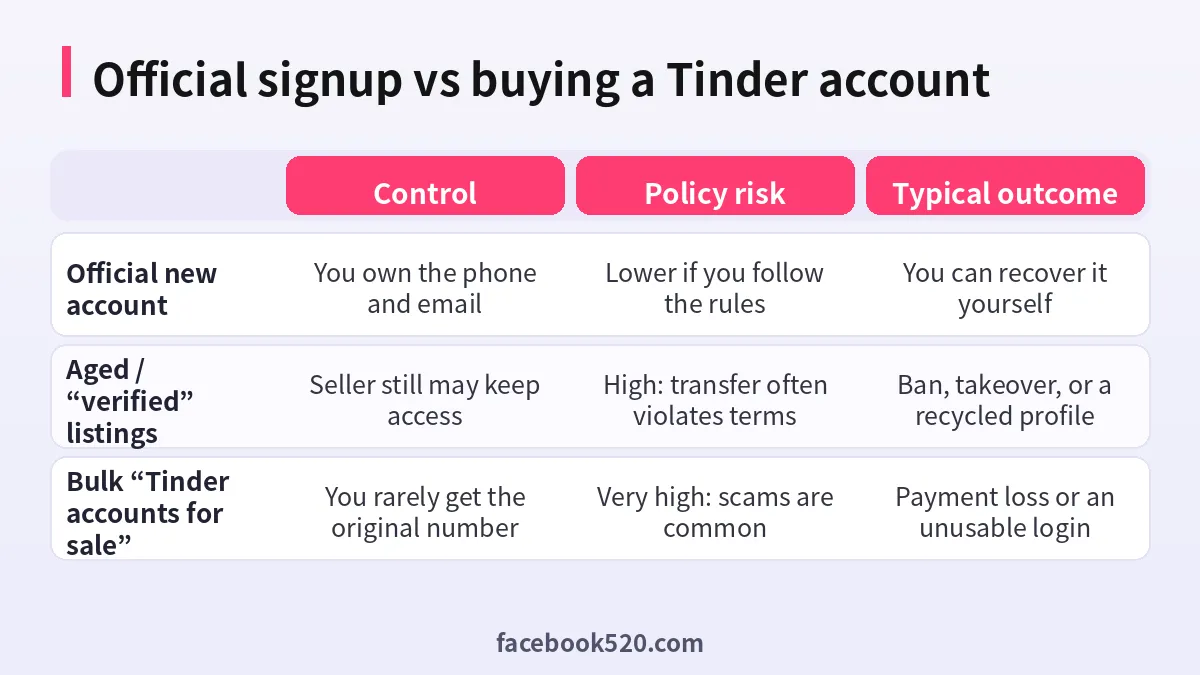
Official sign-up versus buying: a direct comparison
For most people, the official path is slower at the start and more stable afterwards. The bought path looks faster and then fails at the point you need it most: recovery, payment, or a review by Tinder.
| Question | Create an official Tinder account | Buy a Tinder account |
|---|---|---|
| Who controls the phone number? | You do | Often still the seller |
| Can you pass photo or ID checks? | Yes, as yourself | Risky: the face or documents may not match you |
| What happens if the app asks for a code? | You receive it | You wait on the seller, or you are locked out |
| Policy standing | A normal new or existing user account | May already violate transfer rules |
| If something goes wrong | You can use official in-app support and recovery | Tinder has no obligation to honor a third-party sale |
| Hidden history | You know how the account was used | You inherit reports, bans, or other people’s photos |
The comparison is not even close for a personal dating profile. If your goal is to use Tinder as intended, create the account yourself. If your previous account was banned, an official appeal—or starting fresh on a clean basis after you understand the reason—is still the path that Tinder recognizes.
What listings claim, and what usually happens after payment
Public listings tend to repeat the same phrases: “aged,” “full email access,” “verified,” “no ban,” “instant delivery.” Here is how those claims often play out in practice.
- Aged. Account age is not a shield. A transferred login can still be reviewed when the device, location, or payment method changes. Age also says nothing about whether the profile already collected reports.
- Full email access. Email access without the phone number is incomplete. Many resets still go to the number. If the seller keeps a copy of the mailbox, they can also regain entry.
- Verified. Photo verification is tied to a face. If you are not that person, a later check can fail. Buying a “verified” badge you cannot personally repeat is a short-lived advantage.
- Instant delivery. A password in a chat window is not a completed handover. Until you change the number, email, and any payment method—and confirm that the seller can no longer receive codes—the account is not yours.
After payment, typical failure modes are: the password does not work; the account is already logged out and asking for an SMS the seller stops sending; the profile is banned within hours of a new device login; or the seller resells the same login to someone else. None of these is rare.
If you are only evaluating an offer, what would a real handover even require?
We do not recommend buying a Tinder account. If you are researching why these offers fall apart, it helps to know what a complete handover would have to include—and why most listings cannot provide it.
- Live confirmation that the profile opens, with the current phone number and email visible in settings.
- Transfer of the phone number itself, not an SMS-forwarding arrangement, plus a change of email that you uniquely control.
- Removal of every other logged-in device and session.
- Replacement of any payment method used for Tinder Plus, Gold, or Platinum.
- A clear written record of what was delivered, for your own protection, knowing that Tinder may still close the account.
If a seller cannot or will not do those things, they are not selling you a durable account. They are selling temporary access. That is the core issue behind almost every “buy Tinder account” complaint thread.
Safer alternatives: official sign-up, recovery, and support
The practical alternative is ordinary and, for that reason, often overlooked.
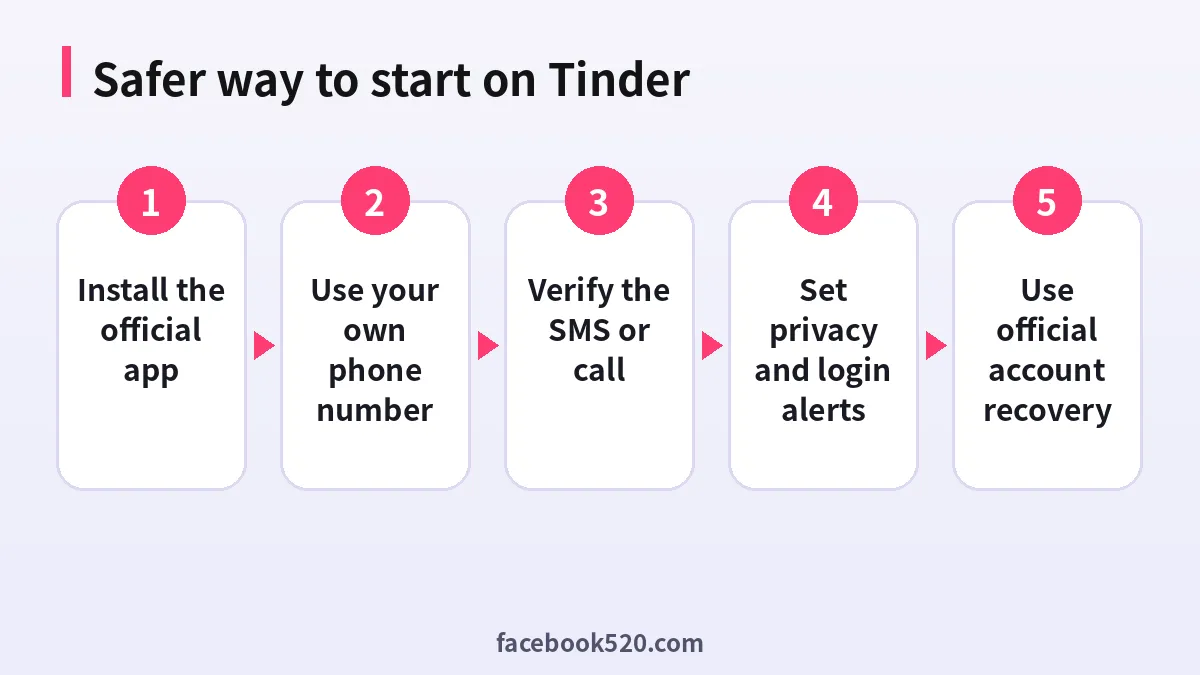
- Install Tinder from the official App Store, Google Play, or the official website. Avoid sideloaded APKs and “modded” clients. Those can steal logins and are a separate risk.
- Register with a phone number you own. Use a number you can keep. Virtual numbers and reused numbers are a common reason sign-up fails or later locks.
- Complete the SMS or voice verification yourself. Then add an email you control and turn on whatever login alerts the app offers.
- Set privacy and safety controls in the official app. Review who can contact you, what is visible, and how you report or block. This is part of using the product, not an add-on you buy from a third party.
- If you already had an account, use official recovery first. The in-app help and Tinder’s published support articles are the correct place to start for a lost login or a restriction. A purchased replacement does not undo an existing ban on your device or identity signals.
If sign-up keeps failing, the cause is often the number, a VPN, a device that already has an account, or a previous restriction—not the absence of a shop selling logins. Fixing the official path is slower, but it leaves you with an account you can actually recover.
Pricing talk, without invented numbers
You will see a wide spread of asking prices for “Tinder accounts for sale,” from very low one-off logins to higher “aged” or “verified” packages. We are not going to publish a fake price list. Public figures change, many listings are not real, and a low price is not a bargain if the login is recycled or banned.
If you are studying the market only as research, treat every quoted figure as an asking price, not a market rate, and assume it is subject to what the seller actually delivers. For a personal dating app, the relevant cost is usually the official subscription (if you want one) and the time to create your own profile—not a third-party invoice.
How this topic differs from buying other social accounts
Readers who already looked at Facebook, Instagram, or YouTube “accounts for sale” sometimes assume Tinder works the same way. It does not.
- A Facebook Page, a YouTube channel, or a LinkedIn Company Page can be a business property with admins and roles. A Tinder profile is a personal dating account.
- Advertising assets (for example a Meta ad account) have billing and spending limits you can inspect. Tinder does not sell a transferable business identity in the same sense.
- The safety expectation is higher. Other people on the app are expecting to interact with a real person, not a resold persona.
For platform-by-platform context, see our list of 108 social media accounts worldwide (Tinder appears there as a dating app, not as a recommended purchase) and the platform hubs. Risk notes for buying Facebook accounts are in the separate English guide Buy Facebook Accounts (2026).
Frequently asked questions
Is it legal or allowed to buy a Tinder account?
You need to read Tinder’s current Terms of Use. In practice, buying or transferring an account is commonly not allowed, and Tinder can close the profile. Local laws about fraud, impersonation, or payment disputes can also apply if a listing is a scam or uses someone else’s photos. This is not legal advice.
Why do Google results show “tinder accounts for sale” on pages that barely mention Tinder?
Some older pages only mention the phrase in a tag or a short list. That can generate impressions with almost no clicks, because the title does not answer the query. This article exists to answer the query directly.
Can a seller transfer Tinder Gold or Platinum to me?
Paid features are billed to a payment method. If that method stays with the seller, the subscription can be cancelled or the account recovered through the store or card. Do not assume a paid badge survives a handover.
What if my old Tinder account was banned?
Use official support and the in-app appeal or help options first. Creating a new official account after a ban may still be restricted. Buying a replacement is not a supported workaround and often leads to another restriction.
Are “aged Tinder accounts” safer than new ones?
Not reliably. Age does not remove transfer risk, and an older profile can carry reports or photo issues you cannot see in a screenshot.
Can I use a virtual phone number to sign up instead of buying?
Some people try. Tinder may reject numbers that have been used many times. A number you own and can keep is the more durable option for official sign-up.
How do I spot a recycled profile?
Repeated photos across sites, a bio that does not match the pictures, a seller who refuses a live login, or a password that already has other sessions open are typical signs.
What should I do if I already paid and the login failed?
Stop sending more money. Save the chat, listing, and payment record. If the payment method allows a dispute, use that process. Do not provide more personal documents to the seller.
Does facebook520.com sell Tinder accounts?
This page is an explanatory guide. We explain risks and official alternatives. If you want platform overviews, use the links above and the platform hubs.
Is there a safer official way to get more visibility on Tinder?
Tinder’s official subscriptions and in-app features, when you choose to use them, are the supported way to add tools to your own account. That is a different decision from buying someone else’s profile.
Conclusion
If you searched for tinder accounts for sale or wanted to buy a Tinder account, the short answer is: the listings are common, the failures are common, and the official app path is the one you can actually recover. A Tinder profile is a personal, phone-verified account, not a transferable business asset. Treat “aged” and “verified” claims with skepticism, watch for scam signs, and use official sign-up or official recovery instead of paying for a login you may lose the same week.
For related reading on social platforms and account-buying risks, continue with the 2026 platform account overview, the worldwide buying checklist, and the platform hubs index.
General information only, updated November 2026. Tinder’s features, prices, and terms change; always check the official app and Tinder’s published policies. We do not invent price lists, and we do not assist with evading a ban.

